An Anglican priest and Alexander technique teacher
Author: Dr. Jennifer Fox Eades
Alexander technique teacher, writer, researcher, education adviser, member of Third Order of Society of St Francis. Interested in the Alexander technique as a source of well-being, contemplative education, stories and storytelling, and embodied learning and praying
Most high, omnipotent good Lord (Our Kindest Grandmother Adored),To you be creaseless praise outpoured,And blessing without measure.From you alone all creatures came,No-one is worthy you to name.
My Lord (God) be praised by Brother (Sister) Sun,Who through the skies his (her) course does run,And shines in brilliant splendour. With brightness he (she) does fill the day,And signifies your boundless sway.
My Lord (God) be praised by Sister Moon,And all the stars that with her soonWill point the glitt’ring heavens.Let wind and air and cloud and calm,And weathers all repeat the psalm.
By Sister Water then be blessed,Most humble, useful, precious, chaste.Be praised by Brother (Sister) Fire;Cheerful is he, (she) robust and bright,And strong to lighten all the night.
By Mother Earth my Lord be praised;Governed by you she has upraisedWhat for our life is needful.Sustained by you though every hour,She brings forth fruit and herb and flower.
My Lord (God) be praised by those who proveIn free forgiveness their loveNor shrink from tribulation.Happy, who peaceably endure;With you Lord (Mother) their reward is sure.
By Death our Sister praised be, From whom no one alive can flee, Woe to the unprepared.But blessed be those who do your willAnd follow your commandments still.
Most High omnipotent good Lord (Our Kindest Grandmother adored)To you be ceaseless praise outpoured and blessing without measure.Let every creature thankful beAnd serve in great humility.
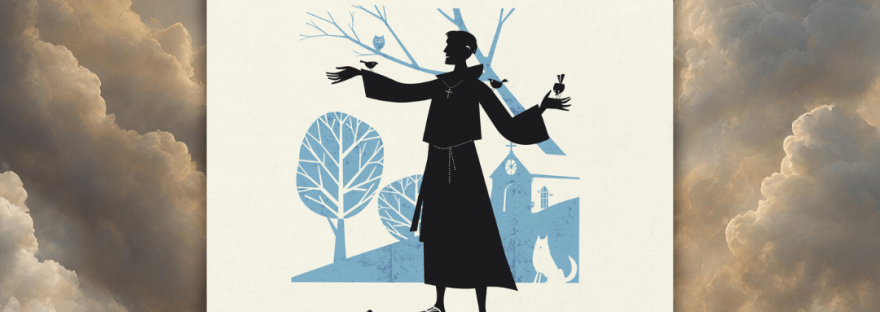
The Canticle of the Creatures is a hymn that St Francis wrote near the end of his life. It expresses his sense of the profound sacredness and inter-connectedness of all creation. I love it and sing a version of it more or less every day, and have done so for nearly 15 years. And I do so – creatively. I quite deliberately play with the words. Because, like most God-talk throughout history and round the world and in all traditions (and all faiths) it assumes that the Holy is male and exclusively names God as He.
Which, at this point in my life and my spiritual path, I find …..unhelpful.
So, generally, I change the genders of Brother Sun and Sister Water – sometimes they are Sister Sun and Brother Water. Playing with the genders gently challenges the stereotype that men are always strong and in control and women are always gentle and pure!
I play with the opening. ‘Most High Omnipotent, good Lord’ becomes ‘Our Kindest Grandmother Adored’. Someone once asked me which woman ‘imaged’ God for me and I knew at once that it was my beloved grandmother. For me, God is not an omnipotent, royal male (God isn’t female either, of course, God is all genders and none). So I lean on that powerful, personal image in my own praying of the Canticle. In the version above my own adaptations are in bold type. You can make your own!
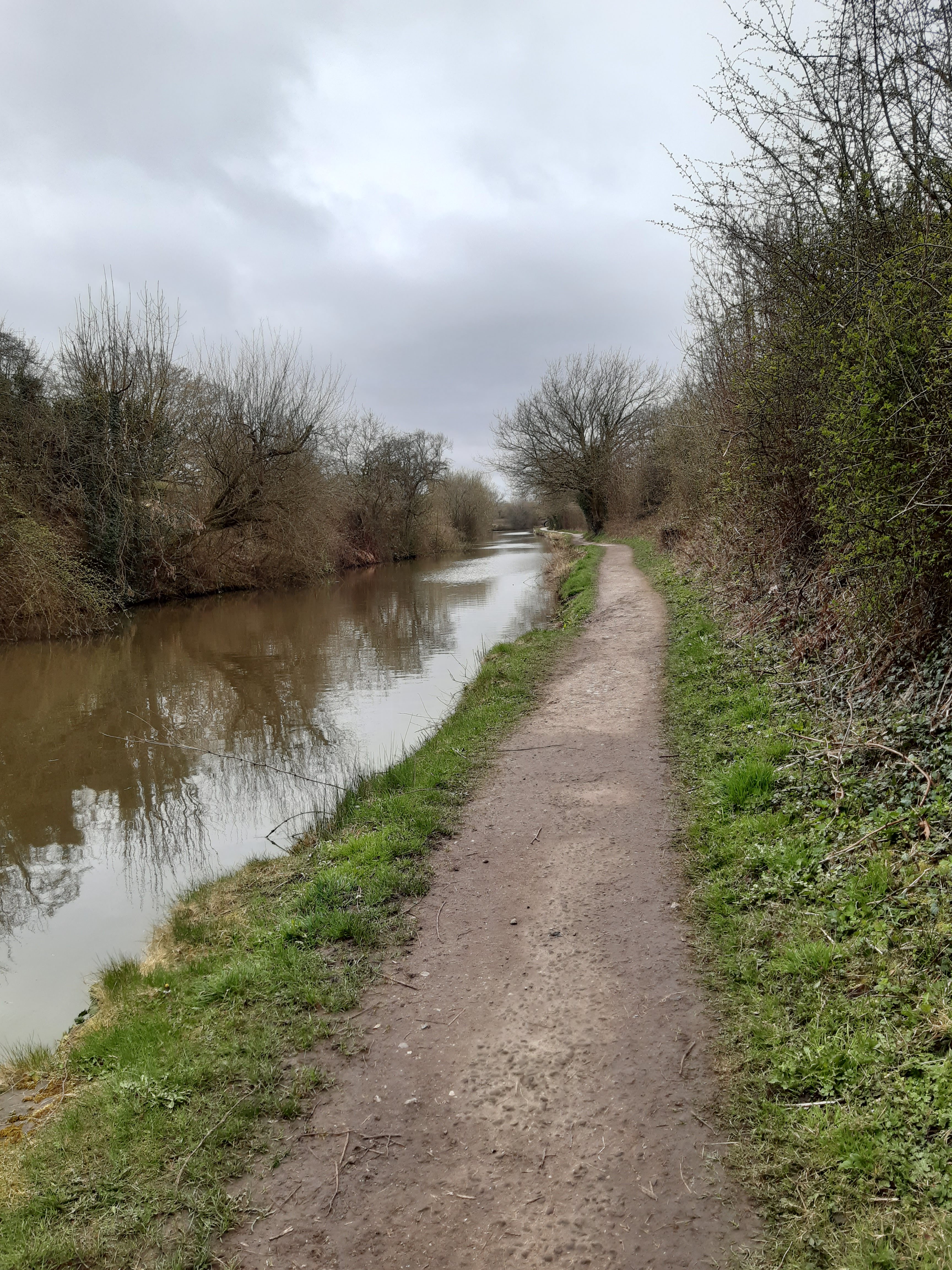
But I sing this version of the canticle while I walk, or run or cycle in God’s good creation.
I began playing with prayer creatively as a young mother of three children. To carve out time alone was sometimes, frankly, impossible so I learned to pray – with my children. I committed prayers to heart so I wasn’t reliant on books and I would sing or say my prayers with them as I went about the work of the day.
It was a very practical decision.
Years later, I committed the Canticle of the Creatures to heart so that I could sing it on my daily run, and still fit in silent prayer before breakfast, caring for my family, working part-time, studying and helping to lead a church. Again, it was a very practical decision.
Now I have more time available I continue to pray creatively, playfully – and now it is a theological decision. And the version I sing is a theoological decision, too.
Humans, made in the image of a creator God are creative at their core. It is never a question of ‘are you creative?’ but ‘how are you creative?’ And I suspect that most, if not all, people of faith are creative in how they pray and when they pray and where they pray. Yes, there is tradition and that can be beautiful and wonderful. And then there is how we practice that tradition – which will change each time we pray because we pray as embodied creatures whose bodies and lives and environments are changing moment by moment.
I have always prayed creatively but if I am honest I have often felt slightly guilty for doing so. Am I praying ‘properly?’ I have asked myself and even, ‘is this allowed?’
Now, I have spent 15 years singing about the Spirit of God incarnate in Sister Sun and Brother Water, Mother Earth and our Grandmother God. I have spent 15 years letting the words of the Canticle sink into my bones with each step as I have run, walked or cycled on our Mother Earth.
And after 15 years I am learning to let go of the guilt and to enjoy my God-given creativity. I am learning to accept that I really am a woman made in image of our creative Mother or Father or Grandmother God – and to be thankful.
Questions for reflection
How are you creative?
Is there an activity in your life you don’t currently see as prayer that you could see as prayer? How might that activity change if you did?
Can you learn by heart – and play with – a part of the Canticle?
A version of this article first appeared in Issue 26 of Little Portion, The Magazine of the Third Order, Society of St Francis, Spring 2025.
My book, Embodying Prayer (2024) is published by Christian Alternative Books
In the wake of the Makin Report and the resignation of the Archbishop of Canterbury I want, as an ordained representative of the Church of England, to express both my sorrow, my shame and my anger – that people have been so profoundly hurt by my church and that that hurt has been covered up and minimised.
There is no place for violence, or violent theology, in our church. No place for racism or sexism or misogyny, classism, ableism or elitism – no place for any ideology that diminishes or wounds human beings.
If you have been hurt in any way by the church or its members please speak up.
SAFEGUARDING INFORMATION
NSPCC
Support to children: Telephone 0800 1111
Adults concerned about a child: Telephone 0808 800 5000
The National Association for People Abused in Childhood (NAPC)
Adult Survivors: Telephone 0808 801 0331
Safe Spaces: a free independent support service for anyone who has been abused
For all reporting and enquiries, please email safeguarding@chester.anglican.org (monitored Monday to Friday, 9am-5pm). For general safeguarding enquiries, call 01928 718834 (Monday to Friday, 9am-5pm).
This has been a week when the world has felt full of angry voices and violent actions. It is a week when those of us who work for peace and kindness and care in our world and in our church have been shocked anew by stories of violence and abuse.
It was a week when, bruised and bewildered by the news of my church’s shame, I wondered what on earth I could say to an assembly full of beautiful children and their equally beautiful hard working teachers.
And as I knelt, early on Wednesday morning, in front of an icon of St Clare, it shone in the light of my candle and I knew what I wanted to say. I knew how I wanted to be. So let me tell you her story……
“Clare was a woman of love, a person of prayer and a person of peace. And she always remembered that she followed Christ, the Prince of Peace.
But the times she lived in were not peaceful times. Men of war, men of violence, meant that life was often dangerous for ordinary women and children and men.
And a story is told about St Clare of how, one day, an army of violent men came to attack the little town of Assisi where Clare lived.
And instead of running away and instead of fighting back, St Clare remembered that she followed Christ, the Prince of Peace. And she went into her little church and brought out a box. And in that box there was a small piece of the bread and a tiny drop of the wine that Christians eat and drink when they remember Christ, the Prince of Peace.
And Clare held that little box and she just stood – and remembered. She remembered all the women and men and children in the town of Assisi. And she remembered Christ, the Prince of Peace. And she remembered that the men of war she could see before her were also children of God.
And on that day, for some reason, the men of war turned back. Some people say they were scared of this little godly woman. I’m not so sure. I think that on that day they, too, remembered peace and remembered that they were children of God. And I think they chose – and it is always a choice, to stand and remember peace and love for themselves.”
So today, sisters and brothers, (and everyone, of any faith, who is reading this IS my sister and my brother) in the face of the violence and injustice and sheer nastiness that can happen in our world I invite you to stand – not to flee and not to fight – but simply to stand for peace, to stand for justice and love and kindness and compassion. And please remember that you – and everyone you meet today – is an infinitely precious child of God.
May She bless you and may She keep you and may She give you Peace.
At the end of this month I have a book coming out, Embodying Prayer. And as I have been reflecting on this important event in my life I have come to realise that I have always done stuff and made stuff to express my deepest feelings.
As a child I made stuff, cuddly toys, aprons, bits of craft projects – and mostly I gave them to my mum to tell her I loved her, that she was so, so important to me.
And of course, I am not unique. All of us give gifts – ‘stuff’ – sometimes shop bought and sometimes homemade – to build up our relationships, to say I value you, you matter to me, I love you.
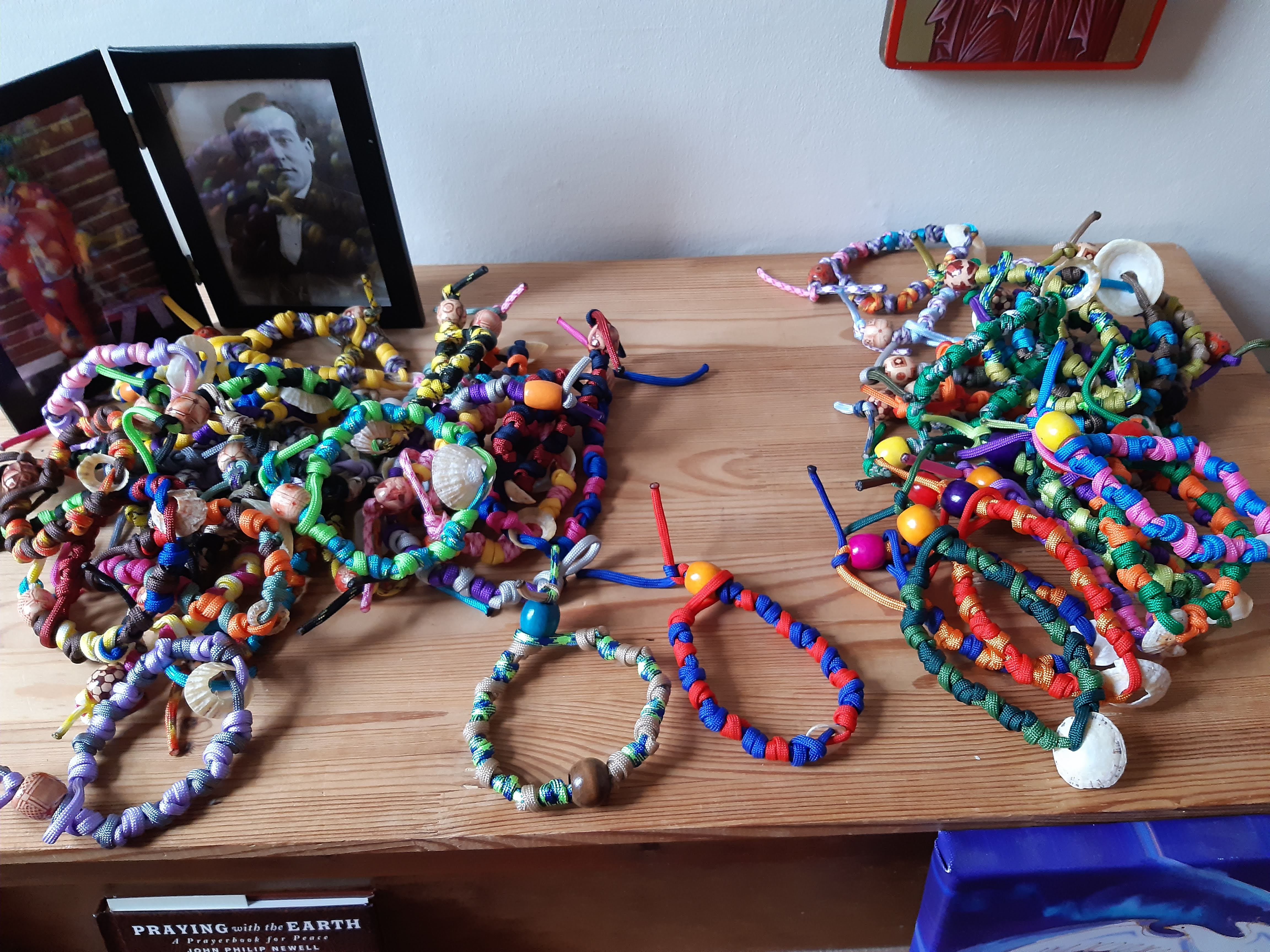
In some ways, wrinkles aside, I haven’t changed much. I spent the spring months this year knotting prayer bracelets to give to year 6 children in Bollington where I serve as a curate – to tell THEM that they are loved – by my church, St Oswald’s, by God. I wanted them to know …..as they headed off to the scary adventure that is high school….that prayer is more than words. And when words fail or beliefs fail you can still pray ….you can light a candle, you can hold a prayer bracelet and remember that you are loved, valuable and that there is help out there. I wanted them to know that they matter – to God, to the world, to St Oswald’s, to me.
At the beginning of July, my little prayer table at home was COVERED in prayer bracelets – and I and folks in the Sunday congregation prayed with every single one of them. The children recieved ‘pre-prayed-with’ prayer bracelets!
Now, my prayer table is a bit emptier – except I now have cards on it with the names of those we gave the bracelets to – because we are still praying for them.
One of the things I love about the Christian faith is that it is INCARNATIONAL – God becoming a body – a person. God saying that stuff – the stuff we humans touch and the kind things we do – are sacred and eternal.
That’s why we light candles in church – to put our prayer into a simple action. And in the service called Holy Communion we eat a tiny bit of bread and drink a sip of wine – to connect us to the infinite, to the eternal, to remind us that we matter to the living God.
I still like making stuff. I knot prayer bracelets. I write books. I blog a bit. Stuff matters. As do you. God bless.
I love donkeys. I love the gentleness of their faces. I love the way they symbolise the humilty of God. I love the legends that surround them. I love the fact that they have a cross on their back – the story of God’s pain drawn in the fur of a donkey.
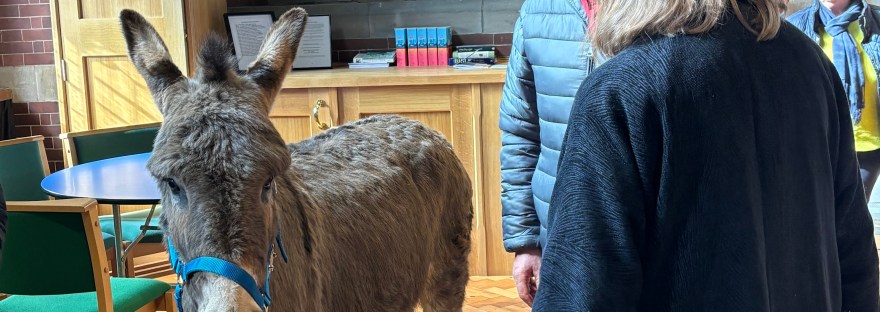
And on Sunday at St Oswald’s we had a visit from a donkey – from Barney the donkey, to be precise. And 40 excited children, 60 adults and one very excited curate got to encounter a living symbol of the humility of our God.
And earlier that morning, before the children and the donkey arrived and filled the church with joyful chaos, I had preached at a quieter service. And I preached on the story that starts off the Passion Liturgy – the nameless woman in Mark 14 who annoints Jesus’ head with perfume of nard.
And drawing on comments made by friends and colleagues in the week leading up to that sermon, I noticed how this woman gave Christ two precious gifts that are often overlooked. One was the gift of actually listening to him and believing him when he said he was going to die. Others around him, the high profile named characters in Mark’s gospel, James, Peter, John…they were in denial. Jesus said he was going to die and they said ‘not on our watch’ you don’t.
This woman looked and listened and saw a man going to his death. It is a gift to be seen. A gift to be heard. A gift to be understood. And it’s a gift she gave Our Lord.
And she annointed his hair with a whole bottle of nard. And when a friend said she had smelt a tiny bit of nard – and that it had filled a room with a clear, spicy, beautiful scent that lingered…I thought that Christ would still have been surrounded by that smell even while he hung on the cross. The memory of this unknown woman, her love and her understanding would have been with him on the cross. Another gift.
It is sometimes said that Christ was abandoned on the cross, to die all alone. I beg to differ. The smell of the nard was with him. His mother was with him. Mary Magdalene was with him. When people say ‘everyone’ ran away what they really mean is all the men ran away, all the important people ran away. Leaving the nameless ones, the unimportant women in the story and the unnamed Disciple whom Jesus loved, standing and waiting with him. Keeping Our Lord company. Giving him the gift of courage in not running away, the gift of waiting with him.
And by entering into the ancient story of Holy Week – whatever our beliefs or unbeliefs – even if only a tiny, tiny bit we join with the nameless ones, the unimportant ones who kept company with the God who rode a donkey. We give a tiny gift to the one who gives us everything.
Walking with Julian – All Shall Be Well (This blog was recently published as an article in Transforming Ministry Magazinehttps://transformingministry.co.uk/)
Meeting Julian
It was the priest who conducted my wedding, some 37 years ago, who first quoted Julian of Norwich to me. “All shall be well and all shall be well and all manner of things shall be well,” he said, to calm my pre-wedding nerves. I had never heard of Mother Julian before, the 14th century anchorite whose visions led her to write what we now know as the spiritual classic, Revelations of Divine Love. However that phrase was a doorway for me into her little cell that I have stepped through frequently over the years and still do today.
That phrase itself, perhaps her best known, was written by a woman living through the plague who may have suffered the deaths of her own children and had certainly suffered serious illness. She constantly ran the risk of being accused of heresy, both because of her sex and because of her radical theology. She was not, in some simplistic way, simply hoping for the best nor does this quote have much to do with the power of positive thinking. It is rather a marker of a deep trust in the kindness and what she calls the ‘friendliness’ and ‘courtesy’ of God. I used to text the phrase to my daughter when she was going through difficult times. It in no way diminishes the challenges of life but puts them into an ultimate perspective where everything that happens and all that exists is held, like the hazelnut of another famous passage, within the gentle and loving hands of God.
If a 14th century anchorite, living through the bubonic plague and the wars and violence and misogyny of that period, living in the midst of fear and death, could say that all will be well then I felt, and still feel, that her deep and radically optimistic theology was a resource to lean on.
A growing presence
Julian has also helped me, and countless other women too, to find some female aspect to the divine in a religion dominated by maleness. In the past 50 years, feminist theologians have raised awareness of the Bible as a document written largely, if not exclusively, for men and one that is full of sexism and misogyny in its portrayal of women. The most widely used metaphors for God – father, king, warrior, slave owner – in the Bible and in our liturgies and hymns, are not only male but patriarchal, assuming relationships of domination and violence.
And while the mostly male authorities of established churches acknowledge that God is beyond all gender and that the words we use for the divine are metaphors, this is often accompanied by a paradoxical instance that it is and will always be wrong to call God anything other than ‘Father’ or ‘Lord’.
The Church of England is just at the beginning of what I expect to be a very long conversation – indeed struggle – about the possibility of naming God as anything other than ‘Father’ and ‘Lord’ in our authorized texts. Sadly, I doubt I will see very much change in my lifetime.
And yet in the midst of that patriarchal context, dear Julian simply calls Jesus ‘our true mother’ and says that ‘the great power of the Trinity is our father and the deep wisdom of the Trinity is our mother’. And while scholars differ about whether Julian can actually be called feminist, she has certainly helped this woman to find her feminist voice.
As a feminist and an academic I felt – and feel – very outnumbered in the Church of England in my desire to name God as She, as well as He; in my belief that the Spirit is calling us, church and society, to move toward a diversity of ways of naming and imagining the Divine. At theological college recently I deeply shocked a dear colleague from a conservative theological background the first time I prayed aloud in the name of our Mother Jesus Christ! So it was a real comfort and, yes, joy to be able to gently share with him that I was NOT doing anything Julian hadn’t already done, many hundreds of years ago!
Female imagery for God is present both in the Bible and, as Julian reminds us, in our tradition but it has been largely overlooked. Some women decide that our established traditions are simply irredeemably patriarchal and walk away. As one of those who remain, as a woman for whom tradition, despite its failings, continues to have beauty and meaning and power, Julian is a great source of help and encouragement.
Lived experience
And Julian helps me find my feminist voice because she took her own female experience – and the female embodied experience more broadly – with the utmost seriousness at a time when only educated elite men were seen to be competent to teach or preach or to discuss theology. She uses the squalor and blood and dirt of the female domestic sphere to draw conclusions about the very nature of God. Claire Gilbert, whose novel I, Julian was published this year, (Byrne, 2023) notes how Julian’s frankness about experiences like constipation, helped her deal with her own drug induced constipation during cancer treatment. Julian’s is no squeamish, sanitized religion. She finds the presence of God in human soil and the soil of the earth and uses those experiences to show that God is not only kind but profoundly understanding, forgiving, nurturing and sustaining.
Julian is still cutting edge for feminist theologians in many ways. Having had her visions at a relatively young age, around thirty, she then spent the next 50 years mining those experiences for profound insights into the nature of God. Today, it is still normal for most theology to be written by elite white men and for their discussions of their experiences of God to be labelled theology while when women or lower status men write about their experiences they are labelled memoir or personalstory. Black women are leading the way in claiming the lived experiences of women as sources of theological reflection and others follow. Writers like Dolores Williams (Williams, 2013) and Eilidh Campbell (Campbell, 2021) build on the foundations laid by Julian of Norwich in giving to women like me the confidence to see ourselves as theologians too and to see the ordinary, messy but dignified struggles of real female life as windows into God.
As a teacher of the Alexander technique, an embodied movement-based contemplative discipline, I draw on Julian in my belief that learning more about our miraculous bodies and paying gentle, appreciative attention to the moment by moment sensations of simple movements, is both prayer and theological reflection. Such physical awareness teaches me and my students more about the Divine Reality that is expressed in and experienced only through our bodies.
A radical writer
In her introduction to the Penguin Classic Edition of Julian’s Revelations, (Spearing, 1998) Elizabeth Spearing makes the point that Julian wrote very much as a woman and this is part of why her work is so distinctive. Male writers had received classical educations based in Latin and rooted in competitive debate where there were winners and losers in argument – a kind of intellectual equivalent to medieval jousting where you learned a subject by fighting over it. This combative kind of writing is sometimes referred to as ‘agonistic’ and it is characteristic of both ancient classical cultures and our own academic traditions (Ong, 1974). This classical influence can be seen in the gospels, perhaps especially in John’s Gospel with its harsh denunciations of opposing views.
Julian, lacking a classical education, simply does not engage in that kind of argumentative writing and it is one of the most refreshing and for me, profoundly healing aspects of her writing. She does not argue for her views. She deeply and gently explores and presents her interpretations and leaves space for the reader to respond as she or he wishes to, as the Spirit moves us to. She is not interested in imposing her view as ‘the right one’ or in convincing her reader that any other view is therefore ‘wrong’. Today, feminist academics challenge the male conventions of combative academia and call for more relational, more creative ways of thinking, reading and writing.
Maggie Ross also notes that Julian uses subtle layers of meaning – Ross calls them ‘word knots’, where a single word can have multiple meanings and, crucially, ‘all meanings are meant’ (Ross, 2018, p. 22). Ross says this is one of the strategies Julian uses to do theology and it is a profoundly contemplative strategy. There is no grasping for a single meaning, a right interpretation or for control of how the reader responds. It is a widening of meaning, an apophatic opening of space for the reader/hearer and for the Spirit to work. Again, I see Julian as an ally and role model and both in my writing and in my preaching, my aim is always to leave space for other views, space for the Spirit to speak.
This contemplative mode of reading Scripture, has opened up for me difficult texts like John’s Gospel and indeed all scripture. There are always multiple readings present in any passage, many possible interpretations and, as Julian saw, ‘all meanings’ may be meant.
It has also provided me with a way to respond generously and with curiosity to other faith traditions, both Christian and beyond. So when I hear simplistic single meanings of Biblical texts used as weapons against vulnerable groups in society I find I turn to Julian and her word knots to wonder how else a text might be interpreted? She shows us, I think, a different and gently powerful way of reading and believing that does not need someone else to be ‘wrong’ so that I can be ‘right’.
Resting in God
One of Julian’s writings that I turn to most frequently is that on prayer. She says that ‘The best prayer is to rest in the goodness of God, knowing that that goodness can reach right down to our lowest depth of need’. I have experienced illness and disability in recent years and have at times struggled with low energy and exhaustion. That phrase constantly reminds me to stop trying so hard, stop trying to do prayer and just to rest, in stillness, in love, in the hands of our Divine Mother and Father and let go.
Julian presents us with a radical vision of God as female as well as male, a challenging willingness to take the reality of life – including women’s lives – as the stuff of theological reflection and a gently contemplative way of doing theology that moves beyond ‘right versus wrong’. Julian’s is a courteous, powerful, positive and above all kind vision of God that I think the world needs very much today.
Byrne, L., 2023. I Julian: The fictional autobiography by Claire Gilbert. Church Times , 6 4.
Campbell, E., 2021. Motherhood and Autism: An Embodied Theology of Motherhood and Disability. London: SCM Press .
Fox, M., 2020. Julian of Norwich: Wisdom in a Time of Pandemic and Beyond. Bloomington: iUniverse.
Llewelyn, R., 1980. Enfolded in Love: Daily Readings with Julian of Norwich. Fourth Edition 2004 ed. London: Darton, Longman and Todd Ltd.
Ong, W. J., 1974. Agonistic Structures in Academia: Past to Present. Daedalus: American Higher Education: Toward an Uncertain Future , 103(4), pp. 229-238.
Ross, M., 2018. Silence: A User’s Guide Volume 2: Application. London: Darton, Longman and Todd Ltd .
Spearing, A., 1998. Introduction and Notes . In: Julian of Norwich, Revelations of Divine Love . s.l.:Penguin , pp. vii-xxxiii.
Williams, D. S., 2013. Sisters in the Wilderness: The Challenge of Womanist God-talk. New York : Orbis .
I heard someone say that the work of a priest is naming the Holy. I liked and remembered that. If I can see – and name – the sacred in the everyday, and in my own life, then perhaps, in a tiny way, I can make it easier for others to see the sacred too, in their own lives and in the lives of those around them.
For centuries the task of naming – and indeed controlling – what counts as sacred has been the work largely (though not exclusively), of elite men. And elite men have reflected on and named as universal their own experiences of God. And this continues to this day.
There are female voices that have come to us from across the centuries but they are few in number, women like Julian of Norwich or Hildegard of Bingen, who widened the kind of experiences claimed as holy and therefore our understanding of what Sacredness means.
Today more voices are claiming their own experiences – their black experiences, their queer experiences, their disabled experiences, their refugee or living in poverty experiences as events where Sacredness happens, where the Spirit is at work. And that means that our sense of what words like ‘God’ mean can, potentially, widen all the more.
So I follow in that tradition by reflecting here on my own experience as a site of the Sacred. And in particular, and in common with other women theologians, I reflect on my own embodied and very physical experience as the place where I encounter the divine. And my everyday embodied and very physical experience recently has involved ….having an operation for a new hip. I have been experiencing bodily aging and fragility, pain and helplessness…. and then the gradual return of health and strength and ease of movement. And for me the question is, how is that sacred?
And firstly, I want to say it is sacred precisely because it has been a physical experience. Centuries of male theology, following Plato, has wanted the sacred to be purely transcendent, purely disembodied spirit, somehow beyond this messy, ordinary life, these imperfect, frail, beautiful bodies. I was undergoing a physical procedure, a medical experience, yes. But I felt profoundly that it was, at the same time, a spiritual experience too.
We only experience the world and God in and through our senses. My Christian tradition says that the Divine nestled in a woman’s womb, walked around, ate, drank, partied (went to the toilet), wept, suffered, died. And the doctrine of the Resurrection of Yeshua, Mary’s son, takes all of that human, wonderful, messiness back into the heart of God and says that it’s the stuff of eternity.
I certainly found myself preparing, very physically, for my hip operation – a little as I remember ‘nesting’ before childbirth – physically preparing the house, clearing space in my study, picking up trip hazards, sorting out and giving away unread books, recycling lecture notes. I felt I was approaching a liminal moment, a before and after experience, and I wanted to create space for that – physically and emotionally and spiritually.
Post-operatively, the physical experience of being ‘off balance’, of not being able to use one of my legs for the first time in nearly 60 years was deeply frightening and unsettling. So at that point I experienced a very physical helplessness and had to, very literally, lean on the kindness of strangers – on the medical staff in the hospital. On the kindness of friends and family, on my husband especially. I had to let go of independence for a while and ask for help, physical help and, indivisible from that, emotional and spiritual help too.
Now as mobility and balance return, I feel a deep physical relief and joy and simple awe at the miraculous – and spiritual – healing properties of the human body.
And I am conscious that this healing is a miracle, that it is grace, pure gift. I don’t make my body heal – it just does. I haven’t somehow earned my hip replacement – throughout history and round the less developed world still, people have to live with the debilitating pain that was my reality just a month ago. So I experience my operation as a sacred gift.
And it is one of the many gifts I have received through this experience. The deeply professional kindness of doctors, nurses, health care assistants was deeply healing. Likewise my dear husband’s kindness and that of the rest of my family and friends. Flowers, cards that arrived unexpectedly. A hip replacement has become routine but it wasn’t routine to ME and I have been so moved and grateful at being thought about, and cared for and prayed for.
And I have received the sacred gift of time in which to heal and the gift of permission to care for myself, for my physical, fleshy self and to prioritize my own needs – something our society grants to women, and perhaps mothers especially, all too rarely.
And it has been an experience of wanting to explore Spirit, to experience God, as female, too. Theologians like Elizabeth Johnson have been calling, for years, for the importance of naming God as She as well as He. And I found myself needing that gift more than ever through this time. Usually I just gently push back at the near exclusively male language for God in our scriptures, sometimes cheerfully, sometimes crossly, quietly and internally changing many of the ‘He’s’ to ‘She’s’, the ‘Lords’ to ‘God’. But through this experience I just didn’t have the energy for that. So I ordered a copy of the Inclusive Bible from my hospital bed and have simply loved being able to read without having to do the substitutions. Someone else had done the work for me and I could thankfully lean on that gift, too.
Johnson says that the Spirit (which in both Hebrew and Aramaic IS linguistically female but is often not translated as such) has always been associated with creativity, with healing, with the movement of God in the world, with care and labour and beauty and liberation. And I have played creatively with my prayers during this time. I have linked my daily exercises with the beautiful, and for me very female, Angelus prayer, so that my exercise becomes prayer and my prayer becomes exercise – my body/spirit finding strength together.
I cultivated beauty in my prayer space and, to help myself cope with the sense of fear and instability I felt early on, I physically wrapped myself in my late mother’s care, wearing a jumper she knitted me and rubbing lavender oil, her favourite scent, into my bruised and battered leg. I lit candles and prayed the rosary by warm comforting light during wakeful nights. I let myself stop worrying about my weight, a lifelong struggle, and ate the nourishing food I craved. I wore clothes and jewellery that were not only comfortable but lifted my spirits because of their colour or links to people and places I loved.
Elizabeth Johnson says, of the Holy Spirit, ‘She is life, movement, colour, radiance, restorative stillness….she purifies, absolves, strengthens, heals…She awakens mighty hope…and this is the mystery of God, in whom we live and move and have our being’ (Johnson, 1992, 2020, p 135.).
If the Spirit is about healing, then this entire experience, the extraordinary skill of the medical profession, the kindness of family and friends, the physical pain, the fear, the need for my mum’s touch, the exploring of creative, female prayer have all been the work of that same Spirit. Psalm 143 prays ‘Let your nurturing Spirit guide me on a safe and level path’. That has been my daily, lived and very physical experience.
In a rather wonderful passage in the book of Ecclesiasticus, (also called Sirach) in the Jewish and Christian scriptures, we are told to ‘Give physicians the respect due their services …Their skill was given to them by God’ and, when ill, advised ‘Pray to YHWH….Then call your physician’ (Ecclesiasticus 38). I think there is a wonderful balance there. Our more secular society wants to split the physical from the spiritual, the medical and scientific from the Holy, the Sacred. I have found throughout this experience that I have wanted to put them back together, where I feel they belong.
Johnson, Elizabeth, (1992, 2020). She Who Is: The Mystery of God in Feminist Theological Discourse. The Crossroad Publishing Company
My version of the legend of St Werburgh: One of my geese is missing
This is a story that is told about a real woman, who really lived, in the North of England and is now the Patron saint of the city of Chester. Whether or not it really happened, I see Werburgh as a real sign that kindness and hospitality and friendship with creation, really matter….
Werburgh was a saint, everybody said so, and they told stories about her kindness. But Werburgh said she just looked and listened and noticed the important things in life. Like the children who played in her cornfield. So Werburgh noticed when a toy horse was lost. And she helped in the search until the horse was found and the tears dried up and the smiles returned. Because Werburgh thought children were important and ought to be noticed
Werburgh was a saint, everybody said so, and they told stories about her kindness. But Werburgh said she just looked and listened and noticed the important things in life. Like the sparrows who nested in her cornfield. So Werburgh noticed when a wing was injured. And she cared for the bird until the wing was healed and the sparrow flew off once more. Because Werburgh thought sparrows were important and ought to be noticed.
Werburgh was a saint, everybody said so, and they told stories about her kindness. But even saints have their limits. And when Werburgh noticed a flock of geese hissing and honking, and waving their long, snake-like necks AND trampling down her corn with their great, webbed feet she called to her neighbour. And she told him the geese could NOT sleep in her cornfield. However, as she was a saint, after all, they could borrow her barn instead.
Now, geese are not known for doing as they are told but, Werburgh was a saint, everybody said so, so the neighbour did as she asked. And, to his amazement, the geese followed him to the barn, hissing and honking and waving their great long snake-like necks as they went.
The next morning, Werburgh went to the barn and opened the door. She looked and listened as the geese waddled out of the barn hissing and honking and waving their great, long, snake-like necks. And then Werburgh noticed something. She noticed that the geese were hissing more sadly than usual. She noticed that their honks were not as loud or as fierce as they usually were. She noticed that they were shaking their great, long, snake like-necks from side to side – as if they were trying to tell her something. And then she noticed that one of the geese was missing.
She called her neighbour and asked him where the missing goose had gone. The neighbour hung his head in shame. He had thought no one would notice if he took one of the geese. He had thought no one would notice if he killed that goose and ate it for his supper. But the geese had noticed, and so had Werburgh.
Werburgh told her neighbour to fetch the bones of the goose he had eaten. And then she prayed, hard, because Werburgh thought geese were important and ought to be noticed and God must have thought so too because, after she had prayed, so our story says, the dry bones were gone and in their place was a hissing, honking goose.
And the goose lowered its great, long, snake-like neck and bowed to Werburgh, to thank her for her kindness in noticing that it was missing. And all the other geese did the same. And then they spread their wings and with a last loud honk they launched themselves into the air and flew away.
So when you see geese flying overhead, and hear their honks filling the air, remember the kindness of Werburgh and the glimpse that she gives us of the kindness and the hospitality of the Divine.
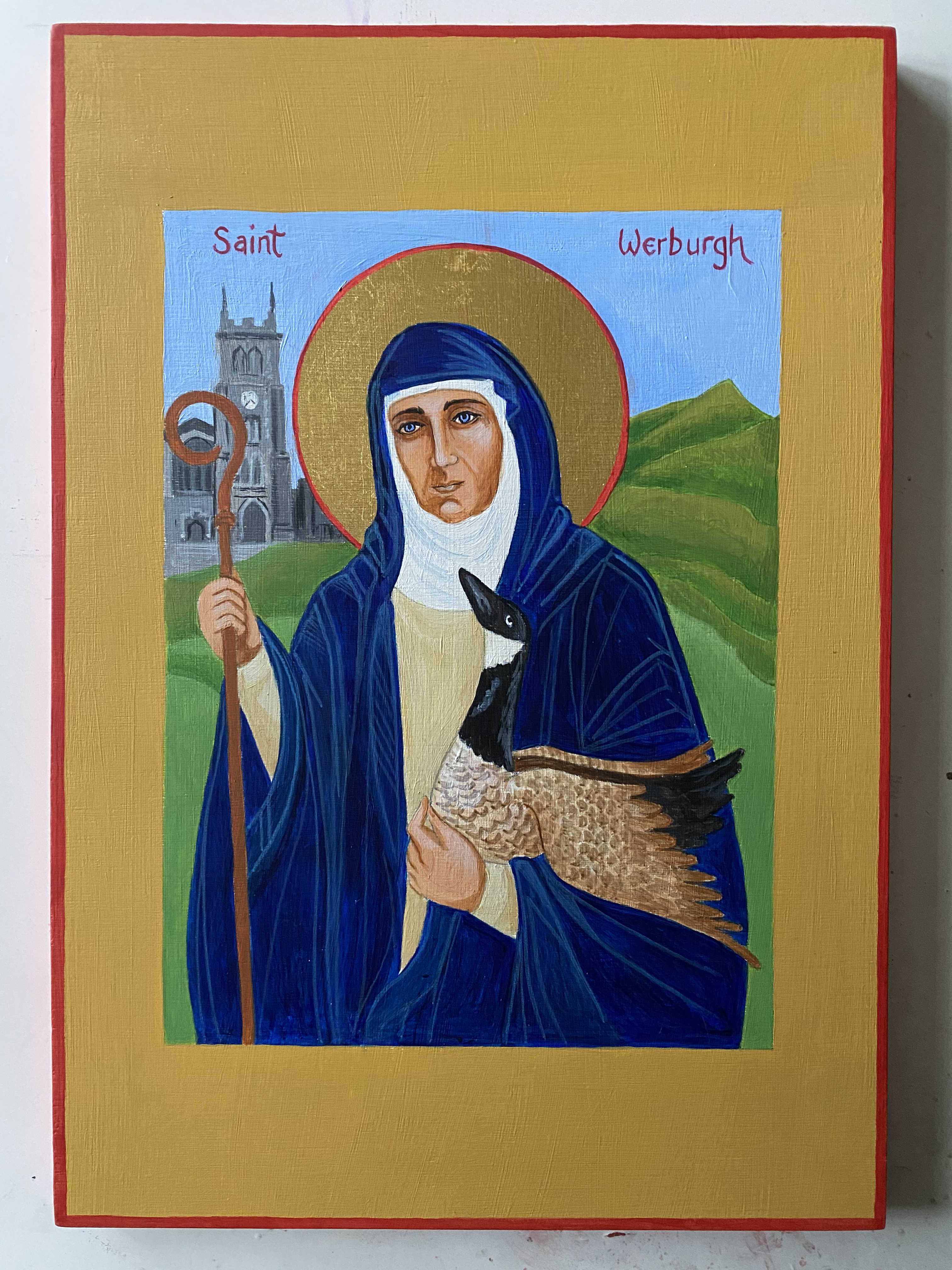
I commissioned this icon of St Werburgh for my 60th birthday.
Wergurgh has associations with Macclesfield, where I live. She is thought to have founded a convent near by. Shuttlingslow, a local landmark, can be seen in the background. St Michael’s and All Angels Church has a window dedicated to her and is the church you can see over her shoulder. The colours she wears are those of Riddings Infants, whose children taught me the power of a simple story, simply told.
And I KNOW that canada geese had not arrived on these shores during her lifetime but they have made Macclesfield their home today and it is today that I think we need the help of the saints to remind us to stop, and look and listen.
You can hear me talk about character strengths and virtues in stories and tell this story here
So, today is Candlemas! Traditionally its when candles where taken into church to be blessed. It occurs 40 days after Christmas, and is known in the church year as The Presentation of Christ in the Temple, when Mary took Jesus to the temple to be blessed.
Snowdrops are sometimes called Candlemas Bells as they tend to open about now. There is a legend about the snowdrop that says an angel took pity on Eve after she and Adam were banished and made a snowdrop bloom as a symbol of hope to cheer her up.
As with many Christian festivals there are echoes of pagan festivals underneath it. Candlemas falls on or around a cross-quarter day, midway between the winter solstice and the spring equinox. So, the days are getting longer again!
Known as Imbolc (lambs’ milk) because the lambing season begins around now it was also called Brigantia for the Celtic female deity of light. In the Christian tradition we recall St Brigid on 1 February.
In some countries pancakes are eaten at Candlemas.
SOoooooo
Light candles
Make pancakes
Take photos of/draw/look closely at snowdrops. Find your hope for the coming year.