My Franciscan Third Order book Lentscapes, https://www.spiritoffrancis.com/lent/ uses the clarity and light of Antartica to reflect on the honesty and the exposure of Holy Week.
By contrast, my Werburgh walk today, over the hills near Macclesfield, was misty and dank – weather Macclesfield does particularly well. And the fog meant I could not see clearly at all.
But perhaps that’s not an inappropriate landscape or weatherscape for the Tuesday of Holy Week either – or for the muddle and confusion of so much of human existence, for that sense of seeking what we can’t quite see, struggling to understand what we can’t quite grasp, for the sense of not knowing and not understanding that often characterises the spiritual path.
And I found myself musing about ‘in groups’ and ‘out groups’ on my walk today, inspired in part by my breakfast reading of Ian Mobsby’s blog, Contemplative Christian. For the Monday of Holy Week Ian wrote about the generous outpouring of divine love represented by Mary, washing Jesus’ feet and annointing him for his death in John 12.1-11 https://www.biblegateway.com/passage/?search=John%2012%3A1-11&version=NIV
This is not a love that guards against vulnerability, that seeks to hold onto status or even dignity. This is a Love, this is a God, who kneels at the feet of people who will betray and lie and seek to engage in violence. And who offers Love to them.
Because Jesus washes Judas’ feet, the person who will betray him to his death; Jesus washes Peter’s feet – the one who will run away and lie to save his own life; Jesus washes the feet of the friends who will abandon him. Perhaps there are other disciples there too, those the artists don’t include – perhaps Mary is there, with her sister, Martha. Perhaps Jesus’ mother is there. Perhaps he washes their feet too – the mists of time have obscured their presence if that was so.
But the point, for me, is that what we are doesn’t matter to whether God kneels before us or not – nor to an extent what we do. Nor does it matter which group we are a part of or NOT a part of – whether we are part of the ‘in group’ or the ‘out group’. God kneels and offers to wash our feet, pours love into a bowl and, if we consent, holds each foot tenderly and soothes away the dust and dirt of our lives, then dries each toe gently and puts our foot back down again.
And it can be hard to recieve, that kind of love. Peter, initially, resists – no Lord, you can’t possibly wash MY feet. And it’s hard to accept, too, that each human person, no matter what they have done or will do, is also offered the same Love, has God kneeling before them offering care, offering kindness.
Just this week I read a post by a (male) priest who was incensed that Sarah Mullalley, our new Archbishop of Canterbury, met with other women on the eve of her installation. He saw, in this gathering of women, evidence of witchcraft and feminism, both clearly meant as insults.
Quite apart from the ignorance this displays, of both witchcraft in it’s modern form and of feminism, I was struck by the fear in that post, the sense of impotent rage screaming about power taken away, status diminished. And yet God kneels in front of that fearful man and offers to wash his feet. And God asks me, as a follower of Jesus, the Christ, to do the same.
And that IS the challenge of Holy Week. To love as Christ loved, not condemning or cursing or hitting back in anger. But kneeling before my Judas, my Peter. And offering to wash their feet. That, for me, is what is exposed in my own soul by the clear light of God’s generous, transparent and universal love. My own reluctance to kneel before those who pour contempt on women, who would take away our hard won rights, and who belittle and mock out of their own fear, their own insecurities, their own littleness of spirit.
I fear such people. And God calls me to walk into and beyond the fear, whether I can see the way clear ahead -or whether the dank mist of Macclesfield obscures the view.
And God also calls me to let my feet be washed by Love that holds my fear – and those of such male priests – in gentle hands. For eternity.
At the end of this month I have a book coming out, Embodying Prayer. And as I have been reflecting on this important event in my life I have come to realise that I have always done stuff and made stuff to express my deepest feelings.
As a child I made stuff, cuddly toys, aprons, bits of craft projects – and mostly I gave them to my mum to tell her I loved her, that she was so, so important to me.
And of course, I am not unique. All of us give gifts – ‘stuff’ – sometimes shop bought and sometimes homemade – to build up our relationships, to say I value you, you matter to me, I love you.
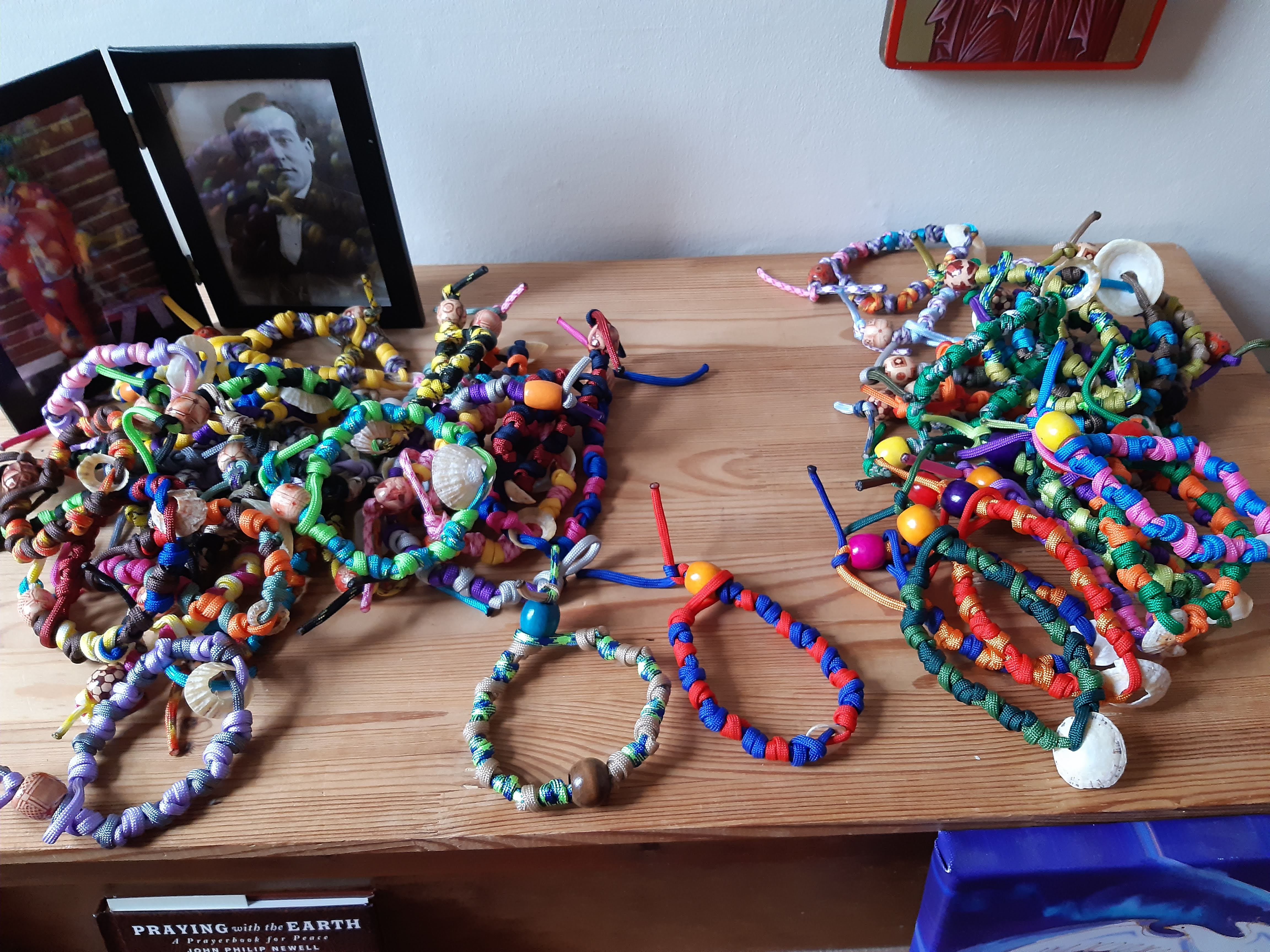
In some ways, wrinkles aside, I haven’t changed much. I spent the spring months this year knotting prayer bracelets to give to year 6 children in Bollington where I serve as a curate – to tell THEM that they are loved – by my church, St Oswald’s, by God. I wanted them to know …..as they headed off to the scary adventure that is high school….that prayer is more than words. And when words fail or beliefs fail you can still pray ….you can light a candle, you can hold a prayer bracelet and remember that you are loved, valuable and that there is help out there. I wanted them to know that they matter – to God, to the world, to St Oswald’s, to me.
At the beginning of July, my little prayer table at home was COVERED in prayer bracelets – and I and folks in the Sunday congregation prayed with every single one of them. The children recieved ‘pre-prayed-with’ prayer bracelets!
Now, my prayer table is a bit emptier – except I now have cards on it with the names of those we gave the bracelets to – because we are still praying for them.
One of the things I love about the Christian faith is that it is INCARNATIONAL – God becoming a body – a person. God saying that stuff – the stuff we humans touch and the kind things we do – are sacred and eternal.
That’s why we light candles in church – to put our prayer into a simple action. And in the service called Holy Communion we eat a tiny bit of bread and drink a sip of wine – to connect us to the infinite, to the eternal, to remind us that we matter to the living God.
I still like making stuff. I knot prayer bracelets. I write books. I blog a bit. Stuff matters. As do you. God bless.
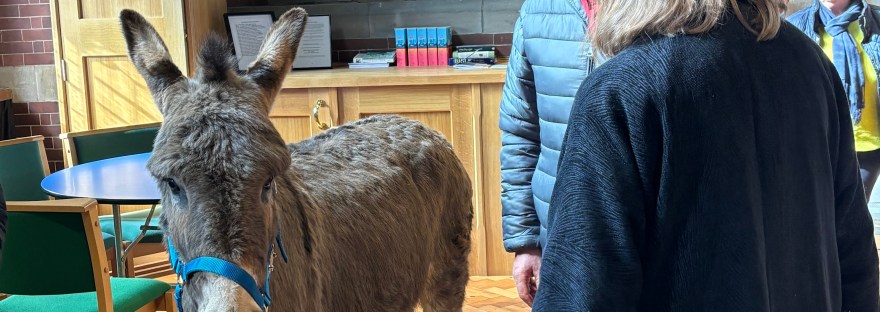
I love donkeys. I love the gentleness of their faces. I love the way they symbolise the humilty of God. I love the legends that surround them. I love the fact that they have a cross on their back – the story of God’s pain drawn in the fur of a donkey.
And on Sunday at St Oswald’s we had a visit from a donkey – from Barney the donkey, to be precise. And 40 excited children, 60 adults and one very excited curate got to encounter a living symbol of the humility of our God.
And earlier that morning, before the children and the donkey arrived and filled the church with joyful chaos, I had preached at a quieter service. And I preached on the story that starts off the Passion Liturgy – the nameless woman in Mark 14 who annoints Jesus’ head with perfume of nard.
And drawing on comments made by friends and colleagues in the week leading up to that sermon, I noticed how this woman gave Christ two precious gifts that are often overlooked. One was the gift of actually listening to him and believing him when he said he was going to die. Others around him, the high profile named characters in Mark’s gospel, James, Peter, John…they were in denial. Jesus said he was going to die and they said ‘not on our watch’ you don’t.
This woman looked and listened and saw a man going to his death. It is a gift to be seen. A gift to be heard. A gift to be understood. And it’s a gift she gave Our Lord.
And she annointed his hair with a whole bottle of nard. And when a friend said she had smelt a tiny bit of nard – and that it had filled a room with a clear, spicy, beautiful scent that lingered…I thought that Christ would still have been surrounded by that smell even while he hung on the cross. The memory of this unknown woman, her love and her understanding would have been with him on the cross. Another gift.
It is sometimes said that Christ was abandoned on the cross, to die all alone. I beg to differ. The smell of the nard was with him. His mother was with him. Mary Magdalene was with him. When people say ‘everyone’ ran away what they really mean is all the men ran away, all the important people ran away. Leaving the nameless ones, the unimportant women in the story and the unnamed Disciple whom Jesus loved, standing and waiting with him. Keeping Our Lord company. Giving him the gift of courage in not running away, the gift of waiting with him.
And by entering into the ancient story of Holy Week – whatever our beliefs or unbeliefs – even if only a tiny, tiny bit we join with the nameless ones, the unimportant ones who kept company with the God who rode a donkey. We give a tiny gift to the one who gives us everything.
Walking with Julian – All Shall Be Well (This blog was recently published as an article in Transforming Ministry Magazinehttps://transformingministry.co.uk/)
Meeting Julian
It was the priest who conducted my wedding, some 37 years ago, who first quoted Julian of Norwich to me. “All shall be well and all shall be well and all manner of things shall be well,” he said, to calm my pre-wedding nerves. I had never heard of Mother Julian before, the 14th century anchorite whose visions led her to write what we now know as the spiritual classic, Revelations of Divine Love. However that phrase was a doorway for me into her little cell that I have stepped through frequently over the years and still do today.
That phrase itself, perhaps her best known, was written by a woman living through the plague who may have suffered the deaths of her own children and had certainly suffered serious illness. She constantly ran the risk of being accused of heresy, both because of her sex and because of her radical theology. She was not, in some simplistic way, simply hoping for the best nor does this quote have much to do with the power of positive thinking. It is rather a marker of a deep trust in the kindness and what she calls the ‘friendliness’ and ‘courtesy’ of God. I used to text the phrase to my daughter when she was going through difficult times. It in no way diminishes the challenges of life but puts them into an ultimate perspective where everything that happens and all that exists is held, like the hazelnut of another famous passage, within the gentle and loving hands of God.
If a 14th century anchorite, living through the bubonic plague and the wars and violence and misogyny of that period, living in the midst of fear and death, could say that all will be well then I felt, and still feel, that her deep and radically optimistic theology was a resource to lean on.
A growing presence
Julian has also helped me, and countless other women too, to find some female aspect to the divine in a religion dominated by maleness. In the past 50 years, feminist theologians have raised awareness of the Bible as a document written largely, if not exclusively, for men and one that is full of sexism and misogyny in its portrayal of women. The most widely used metaphors for God – father, king, warrior, slave owner – in the Bible and in our liturgies and hymns, are not only male but patriarchal, assuming relationships of domination and violence.
And while the mostly male authorities of established churches acknowledge that God is beyond all gender and that the words we use for the divine are metaphors, this is often accompanied by a paradoxical instance that it is and will always be wrong to call God anything other than ‘Father’ or ‘Lord’.
The Church of England is just at the beginning of what I expect to be a very long conversation – indeed struggle – about the possibility of naming God as anything other than ‘Father’ and ‘Lord’ in our authorized texts. Sadly, I doubt I will see very much change in my lifetime.
And yet in the midst of that patriarchal context, dear Julian simply calls Jesus ‘our true mother’ and says that ‘the great power of the Trinity is our father and the deep wisdom of the Trinity is our mother’. And while scholars differ about whether Julian can actually be called feminist, she has certainly helped this woman to find her feminist voice.
As a feminist and an academic I felt – and feel – very outnumbered in the Church of England in my desire to name God as She, as well as He; in my belief that the Spirit is calling us, church and society, to move toward a diversity of ways of naming and imagining the Divine. At theological college recently I deeply shocked a dear colleague from a conservative theological background the first time I prayed aloud in the name of our Mother Jesus Christ! So it was a real comfort and, yes, joy to be able to gently share with him that I was NOT doing anything Julian hadn’t already done, many hundreds of years ago!
Female imagery for God is present both in the Bible and, as Julian reminds us, in our tradition but it has been largely overlooked. Some women decide that our established traditions are simply irredeemably patriarchal and walk away. As one of those who remain, as a woman for whom tradition, despite its failings, continues to have beauty and meaning and power, Julian is a great source of help and encouragement.
Lived experience
And Julian helps me find my feminist voice because she took her own female experience – and the female embodied experience more broadly – with the utmost seriousness at a time when only educated elite men were seen to be competent to teach or preach or to discuss theology. She uses the squalor and blood and dirt of the female domestic sphere to draw conclusions about the very nature of God. Claire Gilbert, whose novel I, Julian was published this year, (Byrne, 2023) notes how Julian’s frankness about experiences like constipation, helped her deal with her own drug induced constipation during cancer treatment. Julian’s is no squeamish, sanitized religion. She finds the presence of God in human soil and the soil of the earth and uses those experiences to show that God is not only kind but profoundly understanding, forgiving, nurturing and sustaining.
Julian is still cutting edge for feminist theologians in many ways. Having had her visions at a relatively young age, around thirty, she then spent the next 50 years mining those experiences for profound insights into the nature of God. Today, it is still normal for most theology to be written by elite white men and for their discussions of their experiences of God to be labelled theology while when women or lower status men write about their experiences they are labelled memoir or personalstory. Black women are leading the way in claiming the lived experiences of women as sources of theological reflection and others follow. Writers like Dolores Williams (Williams, 2013) and Eilidh Campbell (Campbell, 2021) build on the foundations laid by Julian of Norwich in giving to women like me the confidence to see ourselves as theologians too and to see the ordinary, messy but dignified struggles of real female life as windows into God.
As a teacher of the Alexander technique, an embodied movement-based contemplative discipline, I draw on Julian in my belief that learning more about our miraculous bodies and paying gentle, appreciative attention to the moment by moment sensations of simple movements, is both prayer and theological reflection. Such physical awareness teaches me and my students more about the Divine Reality that is expressed in and experienced only through our bodies.
A radical writer
In her introduction to the Penguin Classic Edition of Julian’s Revelations, (Spearing, 1998) Elizabeth Spearing makes the point that Julian wrote very much as a woman and this is part of why her work is so distinctive. Male writers had received classical educations based in Latin and rooted in competitive debate where there were winners and losers in argument – a kind of intellectual equivalent to medieval jousting where you learned a subject by fighting over it. This combative kind of writing is sometimes referred to as ‘agonistic’ and it is characteristic of both ancient classical cultures and our own academic traditions (Ong, 1974). This classical influence can be seen in the gospels, perhaps especially in John’s Gospel with its harsh denunciations of opposing views.
Julian, lacking a classical education, simply does not engage in that kind of argumentative writing and it is one of the most refreshing and for me, profoundly healing aspects of her writing. She does not argue for her views. She deeply and gently explores and presents her interpretations and leaves space for the reader to respond as she or he wishes to, as the Spirit moves us to. She is not interested in imposing her view as ‘the right one’ or in convincing her reader that any other view is therefore ‘wrong’. Today, feminist academics challenge the male conventions of combative academia and call for more relational, more creative ways of thinking, reading and writing.
Maggie Ross also notes that Julian uses subtle layers of meaning – Ross calls them ‘word knots’, where a single word can have multiple meanings and, crucially, ‘all meanings are meant’ (Ross, 2018, p. 22). Ross says this is one of the strategies Julian uses to do theology and it is a profoundly contemplative strategy. There is no grasping for a single meaning, a right interpretation or for control of how the reader responds. It is a widening of meaning, an apophatic opening of space for the reader/hearer and for the Spirit to work. Again, I see Julian as an ally and role model and both in my writing and in my preaching, my aim is always to leave space for other views, space for the Spirit to speak.
This contemplative mode of reading Scripture, has opened up for me difficult texts like John’s Gospel and indeed all scripture. There are always multiple readings present in any passage, many possible interpretations and, as Julian saw, ‘all meanings’ may be meant.
It has also provided me with a way to respond generously and with curiosity to other faith traditions, both Christian and beyond. So when I hear simplistic single meanings of Biblical texts used as weapons against vulnerable groups in society I find I turn to Julian and her word knots to wonder how else a text might be interpreted? She shows us, I think, a different and gently powerful way of reading and believing that does not need someone else to be ‘wrong’ so that I can be ‘right’.
Resting in God
One of Julian’s writings that I turn to most frequently is that on prayer. She says that ‘The best prayer is to rest in the goodness of God, knowing that that goodness can reach right down to our lowest depth of need’. I have experienced illness and disability in recent years and have at times struggled with low energy and exhaustion. That phrase constantly reminds me to stop trying so hard, stop trying to do prayer and just to rest, in stillness, in love, in the hands of our Divine Mother and Father and let go.
Julian presents us with a radical vision of God as female as well as male, a challenging willingness to take the reality of life – including women’s lives – as the stuff of theological reflection and a gently contemplative way of doing theology that moves beyond ‘right versus wrong’. Julian’s is a courteous, powerful, positive and above all kind vision of God that I think the world needs very much today.
Byrne, L., 2023. I Julian: The fictional autobiography by Claire Gilbert. Church Times , 6 4.
Campbell, E., 2021. Motherhood and Autism: An Embodied Theology of Motherhood and Disability. London: SCM Press .
Fox, M., 2020. Julian of Norwich: Wisdom in a Time of Pandemic and Beyond. Bloomington: iUniverse.
Llewelyn, R., 1980. Enfolded in Love: Daily Readings with Julian of Norwich. Fourth Edition 2004 ed. London: Darton, Longman and Todd Ltd.
Ong, W. J., 1974. Agonistic Structures in Academia: Past to Present. Daedalus: American Higher Education: Toward an Uncertain Future , 103(4), pp. 229-238.
Ross, M., 2018. Silence: A User’s Guide Volume 2: Application. London: Darton, Longman and Todd Ltd .
Spearing, A., 1998. Introduction and Notes . In: Julian of Norwich, Revelations of Divine Love . s.l.:Penguin , pp. vii-xxxiii.
Williams, D. S., 2013. Sisters in the Wilderness: The Challenge of Womanist God-talk. New York : Orbis .
I heard someone say that the work of a priest is naming the Holy. I liked and remembered that. If I can see – and name – the sacred in the everyday, and in my own life, then perhaps, in a tiny way, I can make it easier for others to see the sacred too, in their own lives and in the lives of those around them.
For centuries the task of naming – and indeed controlling – what counts as sacred has been the work largely (though not exclusively), of elite men. And elite men have reflected on and named as universal their own experiences of God. And this continues to this day.
There are female voices that have come to us from across the centuries but they are few in number, women like Julian of Norwich or Hildegard of Bingen, who widened the kind of experiences claimed as holy and therefore our understanding of what Sacredness means.
Today more voices are claiming their own experiences – their black experiences, their queer experiences, their disabled experiences, their refugee or living in poverty experiences as events where Sacredness happens, where the Spirit is at work. And that means that our sense of what words like ‘God’ mean can, potentially, widen all the more.
So I follow in that tradition by reflecting here on my own experience as a site of the Sacred. And in particular, and in common with other women theologians, I reflect on my own embodied and very physical experience as the place where I encounter the divine. And my everyday embodied and very physical experience recently has involved ….having an operation for a new hip. I have been experiencing bodily aging and fragility, pain and helplessness…. and then the gradual return of health and strength and ease of movement. And for me the question is, how is that sacred?
And firstly, I want to say it is sacred precisely because it has been a physical experience. Centuries of male theology, following Plato, has wanted the sacred to be purely transcendent, purely disembodied spirit, somehow beyond this messy, ordinary life, these imperfect, frail, beautiful bodies. I was undergoing a physical procedure, a medical experience, yes. But I felt profoundly that it was, at the same time, a spiritual experience too.
We only experience the world and God in and through our senses. My Christian tradition says that the Divine nestled in a woman’s womb, walked around, ate, drank, partied (went to the toilet), wept, suffered, died. And the doctrine of the Resurrection of Yeshua, Mary’s son, takes all of that human, wonderful, messiness back into the heart of God and says that it’s the stuff of eternity.
I certainly found myself preparing, very physically, for my hip operation – a little as I remember ‘nesting’ before childbirth – physically preparing the house, clearing space in my study, picking up trip hazards, sorting out and giving away unread books, recycling lecture notes. I felt I was approaching a liminal moment, a before and after experience, and I wanted to create space for that – physically and emotionally and spiritually.
Post-operatively, the physical experience of being ‘off balance’, of not being able to use one of my legs for the first time in nearly 60 years was deeply frightening and unsettling. So at that point I experienced a very physical helplessness and had to, very literally, lean on the kindness of strangers – on the medical staff in the hospital. On the kindness of friends and family, on my husband especially. I had to let go of independence for a while and ask for help, physical help and, indivisible from that, emotional and spiritual help too.
Now as mobility and balance return, I feel a deep physical relief and joy and simple awe at the miraculous – and spiritual – healing properties of the human body.
And I am conscious that this healing is a miracle, that it is grace, pure gift. I don’t make my body heal – it just does. I haven’t somehow earned my hip replacement – throughout history and round the less developed world still, people have to live with the debilitating pain that was my reality just a month ago. So I experience my operation as a sacred gift.
And it is one of the many gifts I have received through this experience. The deeply professional kindness of doctors, nurses, health care assistants was deeply healing. Likewise my dear husband’s kindness and that of the rest of my family and friends. Flowers, cards that arrived unexpectedly. A hip replacement has become routine but it wasn’t routine to ME and I have been so moved and grateful at being thought about, and cared for and prayed for.
And I have received the sacred gift of time in which to heal and the gift of permission to care for myself, for my physical, fleshy self and to prioritize my own needs – something our society grants to women, and perhaps mothers especially, all too rarely.
And it has been an experience of wanting to explore Spirit, to experience God, as female, too. Theologians like Elizabeth Johnson have been calling, for years, for the importance of naming God as She as well as He. And I found myself needing that gift more than ever through this time. Usually I just gently push back at the near exclusively male language for God in our scriptures, sometimes cheerfully, sometimes crossly, quietly and internally changing many of the ‘He’s’ to ‘She’s’, the ‘Lords’ to ‘God’. But through this experience I just didn’t have the energy for that. So I ordered a copy of the Inclusive Bible from my hospital bed and have simply loved being able to read without having to do the substitutions. Someone else had done the work for me and I could thankfully lean on that gift, too.
Johnson says that the Spirit (which in both Hebrew and Aramaic IS linguistically female but is often not translated as such) has always been associated with creativity, with healing, with the movement of God in the world, with care and labour and beauty and liberation. And I have played creatively with my prayers during this time. I have linked my daily exercises with the beautiful, and for me very female, Angelus prayer, so that my exercise becomes prayer and my prayer becomes exercise – my body/spirit finding strength together.
I cultivated beauty in my prayer space and, to help myself cope with the sense of fear and instability I felt early on, I physically wrapped myself in my late mother’s care, wearing a jumper she knitted me and rubbing lavender oil, her favourite scent, into my bruised and battered leg. I lit candles and prayed the rosary by warm comforting light during wakeful nights. I let myself stop worrying about my weight, a lifelong struggle, and ate the nourishing food I craved. I wore clothes and jewellery that were not only comfortable but lifted my spirits because of their colour or links to people and places I loved.
Elizabeth Johnson says, of the Holy Spirit, ‘She is life, movement, colour, radiance, restorative stillness….she purifies, absolves, strengthens, heals…She awakens mighty hope…and this is the mystery of God, in whom we live and move and have our being’ (Johnson, 1992, 2020, p 135.).
If the Spirit is about healing, then this entire experience, the extraordinary skill of the medical profession, the kindness of family and friends, the physical pain, the fear, the need for my mum’s touch, the exploring of creative, female prayer have all been the work of that same Spirit. Psalm 143 prays ‘Let your nurturing Spirit guide me on a safe and level path’. That has been my daily, lived and very physical experience.
In a rather wonderful passage in the book of Ecclesiasticus, (also called Sirach) in the Jewish and Christian scriptures, we are told to ‘Give physicians the respect due their services …Their skill was given to them by God’ and, when ill, advised ‘Pray to YHWH….Then call your physician’ (Ecclesiasticus 38). I think there is a wonderful balance there. Our more secular society wants to split the physical from the spiritual, the medical and scientific from the Holy, the Sacred. I have found throughout this experience that I have wanted to put them back together, where I feel they belong.
Johnson, Elizabeth, (1992, 2020). She Who Is: The Mystery of God in Feminist Theological Discourse. The Crossroad Publishing Company
This can be a gloomy, decorations down, back to work/school in the dark time of year. But, celebrating is GOOD for us and the more we do, the better we feel.
So, why not, as you take down the tinsel and cards, celebrate Epiphany, which is when the Magi, (wise men – or women!) actually arrive in the Christmas story?
You could: Bake an Epiphany Cake – google it and you’ll find lots of recipes.
And/Or hold a little ceremony and Chalk the Door as a house/classroom blessing and an expression of hopefulness for the year ahead?
The custom of chalking the door is an old Epiphany custom, one that is still used and is growing in popularity again.
So, 20+C+M+B+24 – The 20 and the 24 refer to the date, the + to the Cross of Christ and the C M B EITHER represent the traditional names of the Magi, Caspar, Melchior, Balthazar OR Christus mansionem benedicat – Christ bless this house.
So, why not…..
Celebrate Ephiphany by reading the story of the Magi from Matthew’s Gospel, Chapter 2 and chalking your door or the door of a friend or relative. Teachers, you might process around your school and chalk every door you can find!
Here’s the reading…
“After Jesus’ birth, Wise Men from the east came to Jerusalem. They asked, “Where is the child has has been born to be king of the Jews?…..King Herod sent them to Bethlehem…The star they had seen when they were in the east went ahead of them. It finally stopped over the place where the child was….
The Wise Men went to the house. There they saw the child with his mother Mary. They bowed down and worshipped him. Then they opened their treasures. They gave him gold, incense and myrrh”
Then Chalk 20 + C+ M+B+24 (in any colour) and say, if you wish,
God is love. The infant Christ was born as God’s love on earth. Christ dwells within each loving person, each loving act.
May God dwell in us and in this house/classroom in 2024. May She/He bless us richly and may we be God’s blessing to others. Amen
And you might talk before or after about your hopes as a family/class for 2024 – personal or as a community.
And THEN eat more gold coins……….and cake!
With thanks to Mark Earey at the Queens Foundation, Birmingham, https://www.queens.ac.uk/ for this idea.
Given the coverage of the Lambeth Conference in both church and secular press in recent weeks I have decided it is time to say clearly and simply that I am an ordinand (trainee priest) in the Church of England who hopes, and prays, that my church will soon end its discrimination agains LGBTQ+ people (and end discrimination on grounds of sex, class, race, disability and age, too). I hope and pray that we will welcome and respect all equally and marry same sex couples, as the Episcopal Scottish Church, the Chuch of Scotland, the Church of Wales and the Methodists in the UK have decided to do.
And I hope, very much, that he meets her and listens to her and that they become friends.
Because, most of all, I want us to learn to disagree better – without shouting at each other, walking out of the room, or going to war. I don’t, personally, think Jesus of Nazareth said ANYTHING about sexuality. What he taught us was how to tackle the difficult task of being human, well and how to challenge antihuman forces, practices and beliefs that bring death to people, rather than life.
The issue around sexuality masks a deeper issue that is really about the different ways people of faith read their holy texts. Do we read them literally, as handbooks, telling us what to do and what not to do? Or do we read them as complex products of their time and place, holy poetry, Wisdom literatures that can and do speak to us and inspire us but which also come to us from violent times and places where women, children, sexual minorities, the disabled were seen as ‘less’ than?
With other feminist theologians I want to point out that our scriptures and our creeds were written by and mostly about the actions and beliefs of powerful (straight) men and present us with male imagery for a powerful and masculine God. Our holy texts have been and still are mis-used to oppress and bring death, not life, despair and hate, not hope.
That does not mean I reject the bible or the traditions of my church but I don’t simply ‘accept’ them either. They are to be wrestled with, argued with and searched for the treasures they can and still do yield to us. I revere the bible but I don’t think it’s a simple book with a single message. It inspires and moves me, angers me and troubles me, comforts me and helps me to be human.
And as there are many voices and messages in the bible, though some are quieter than others, so I would like us as people of faith to acknowlege the value of multiple perspectives, many voices. I want us to listen to the voices of the LGBTQ+ community, of children, of women and the poor and the disabled, of minorities and learn what they can tell us of the Divine.
And I very much want Christianity to move on from its obsession with disapproving of what people do in bed and to focus much more on that difficult task of being human, well. Because that’s what I think religion is for …. to help us to be kinder to each other and to the planet and to ourselves. Simple. Albeit, not easy.
Something not many people know about me is that I love going barefoot and always have. I nearly decided to go barefoot when preaching this sermon but then realised that that would be one of those sermon illustrations my preaching tutor warned us about, which is SO exciting and unusual that people get totally distracted and end up not listening to a word you say – so my listeners would be thinking, what is this mad woman doing coming to church with no shoes on – and the rest of the sermon would pass by unnoticed.
So…I kept my shoes on and went metaphorically barefoot instead!
I go barefoot at home for most of the summer, I often go barefoot in the garden, I have even gone barefoot running – which is a thing now – and I did a lot of martial arts as a child – all of which is done barefoot. In fact it still strikes me as a little odd that we don’t take our shoes off when we come into church. Other traditions – Buddhists , my Muslim friends – all take off their shoes when entering a sacred space but Christians don’t. I suspect in our climate that has a lot to do with the fact that we build with stone and we would all have chilblains by the end of the winter.
The reason I am telling you all this is that I think it matters how Jesus sends out his followers in the passage from Luke we heard read for us. Not only are they to take no purse or bag but no sandals either and at least one translation I read said, quite explicitly, go barefoot.
Why might that matter. Well, as someone said when they read that translation, it’s hard to trample on other people when you’re barefoot. And that may explain the popularity of the barefoot schools movement – it started in Scandinavia and has spread here. Everyone in the school, staff, children, visitors, take off their shoes. The education professor researching the results – which range from improved academic results and behaviour to a decline in bullying and carpet wear and tear – says his pet theory is that teenage boys keep their testosterone in their shoes. As that person said, it’s hard to trample on people when you’re barefoot.
Going barefoot in the ancient world was a sign of humility, of low status. Spiritual teachers might well go barefoot – it was the rich, the powerful who wore shoes.
And when you go barefoot you have to tread more gently, you have to keep more aware of the ground under your feet, of the terrain in front of you – you literally have to tread lightly on the earth.
You are, in fact, less protected and more vulnerable. So, when Jesus sends out people to carry on his work, he asks them to go humbly, gently, to let themselves be vulnerable. Lambs among wolves. As Jesus was humble, gentle, vulnerable – a lamb among wolves.
The spiritual life is not, or never should be, about trampling on others. It is about being vulnerable, gentle, humble.
But here’s the thing about lambs. They are vulnerable. They are also wonderfully playful. I heard a great sermon last term where one of our tutors told us that that thing that lambs do when they jump straight up in the air? It’s called stoating! Because, apparently, stoats do it too. Lambs are exuberant, joyful. And that’s the other truth about the spiritual life, the call to follow in the footsteps of Jesus of Nazareth – it is, or it should be, also about playfulness and joy, as well as vulnerability.
Workers or teachers? Or even learners?
This text is often spoken of in the context of the word mission, a sending out to spread good news. But notice how, in addition to the fact that those engaging in mission should go barefoot, so they can’t possibly trample on anyone, they were also told to be open to receive, as well as to give. They received hospitality. If their host was a person of peace they shared in that peace. They were fed. In response they were to heal, to make people whole and they were to teach – the word for worker or labourer could also mean teacher – and what they were teaching was that the ‘kingdom of God’ was near.
It is easy to think of mission as some we do to others. Here mission is two way, as true teaching is always two way. The true teacher is always also learning from others. Here the people Jesus sends are also receiving blessings from those they meet and bless. Mission, the work of God in the world to bring about justice and peace and kindness – is always reciprocal and should always promote the welfare of everyone involved.
The other thing about teaching is that you cannot teach what you are not practising yourself. We cannot teach others that the kingdom of heaven is near if we are not ourselves always learning to see that the kingdom is at hand. And that is a hard practice and a lifelong practice. It is the practice of paying attention. An attentiveness that is encouraged by going barefoot, though I am not suggesting you literally go barefoot in Stockport. But more that you might think about what it means for the spiritual life to walk gently and with awareness. To stay awake. To notice the beauty around you. The beauty in each person. To recall moment by moment that God is near, that the person with me is a child of God, that the kingdom is at hand.
You’ll never walk alone
So Jesus sends us out barefoot, to walk gently. To be vulnerable but playful. To receive as well to give. And he sends us in pairs. We might be vulnerable, in whatever role or calling we are walking in, but we are not alone.
On Monday I took part in about 45 minutes of what we call Holy Listening though it’s more properly called Lectio divina or holy reading. It’s a kind of prayer using the bible. About 7 people gathered at St Peter’s Macclesfield and we sat and read and reread the passage that would be preached on this morning. There’s a lot of silence and a lot of listening and then people shared what they felt spoke to them in the passage. And some of the ideas in my sermon came from people’s sharings. It’s less MY sermon and more a group effort. And that’s a lovely metaphor for the spiritual life and for church life. It is, it should always be, collaborative.
Holy listening in a small group on a Monday morning is a terrific way to start the week and I commend it to you as something to think about – not least because it’s a great way for you to love and support your clergy and help them with their sermon preparation. But also because it builds community – it builds the kingdom of heaven. Some writers now are using the word ‘kin-dom’ rather than Kingdom – for various reasons but importantly because it makes the point that we are all sisters and brothers in the realm of God and that everyone belongs here.
I started this sermon with a prayer taken from our Galatians passage:
“Far be it for me to glory except in the cross of our Lord Jesus Christ, through whom the world is crucified to me, and I to the world’
So, what is this ‘world’ that is crucified to me? Well, it’s the world that says being vulnerable is stupid and for losers. The world that says it’s ok to trample on others and which sees gentleness as a sign of weakness. The world that is preoccupied with efficiency and success – going barefoot isn’t efficient and Christ’s death was not a success. That is the world that is crucified. But the resurrection hope on the other side of that is that the kin-dom of heaven is close at hand, then, now, in and around each of us and we are all constantly being called into newness, into the future, into hope and gentleness and the playful vulnerability that is at the heart of the kin-dom of heaven.
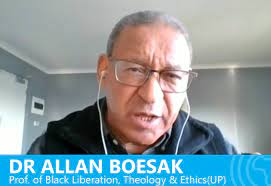
One of the privileges of studying theology and ministry at The Queens Foundation https://www.queens.ac.uk/ is that we are able to learn from superb Black academics like Dr Carlton Turner and Dr Dulcie Dixon-McKenzie. And they, in turn, introduce us to a wider world of theology and struggle and resistance and liberation. And to seasoned activist theologians like Professor Allan Boesak who, at the age of 77, is still a thorn in the flesh of unjust powers.
It is a conversation between Dulcie and Professor Boesak entitled Preaching Hope and Resistance in Times of Struggle and was an hour very well spent. I commend it.
I remember Allan Boesak from my youth but at that time did not clearly understand the depth of the anguish and suffering of Apartheid or the complicity of the White Christian churches.
And what impressed me most, from this interview, was that Allan Boesak is STILL thinking and changing and growing. His theology is as relevant today in the struggles we face against sexism, classism, homophobia, exploitation and ecocide as in the ongoing struggle against racism that he has devoted his life to. Jesus, Allan says repeatedly, was and IS a revolutionary and to walk his Way is to walk the way of struggle and justice.
His latest book is Children of the Waters of Meribah: Black Liberation Theology, the Miriamic Tradition, and the Challenges of 21st Century Empire. It’s a book that argues for the voices of women in Scripture, voices of peace to set against the violence of Empire. I haven’t read it yet. It has just gone to the top of my ‘to read’ list…..






 Jennifer Fox Eades: Alexander Technique Teacher