At the end of this month I have a book coming out, Embodying Prayer. And as I have been reflecting on this important event in my life I have come to realise that I have always done stuff and made stuff to express my deepest feelings.
As a child I made stuff, cuddly toys, aprons, bits of craft projects – and mostly I gave them to my mum to tell her I loved her, that she was so, so important to me.
And of course, I am not unique. All of us give gifts – ‘stuff’ – sometimes shop bought and sometimes homemade – to build up our relationships, to say I value you, you matter to me, I love you.
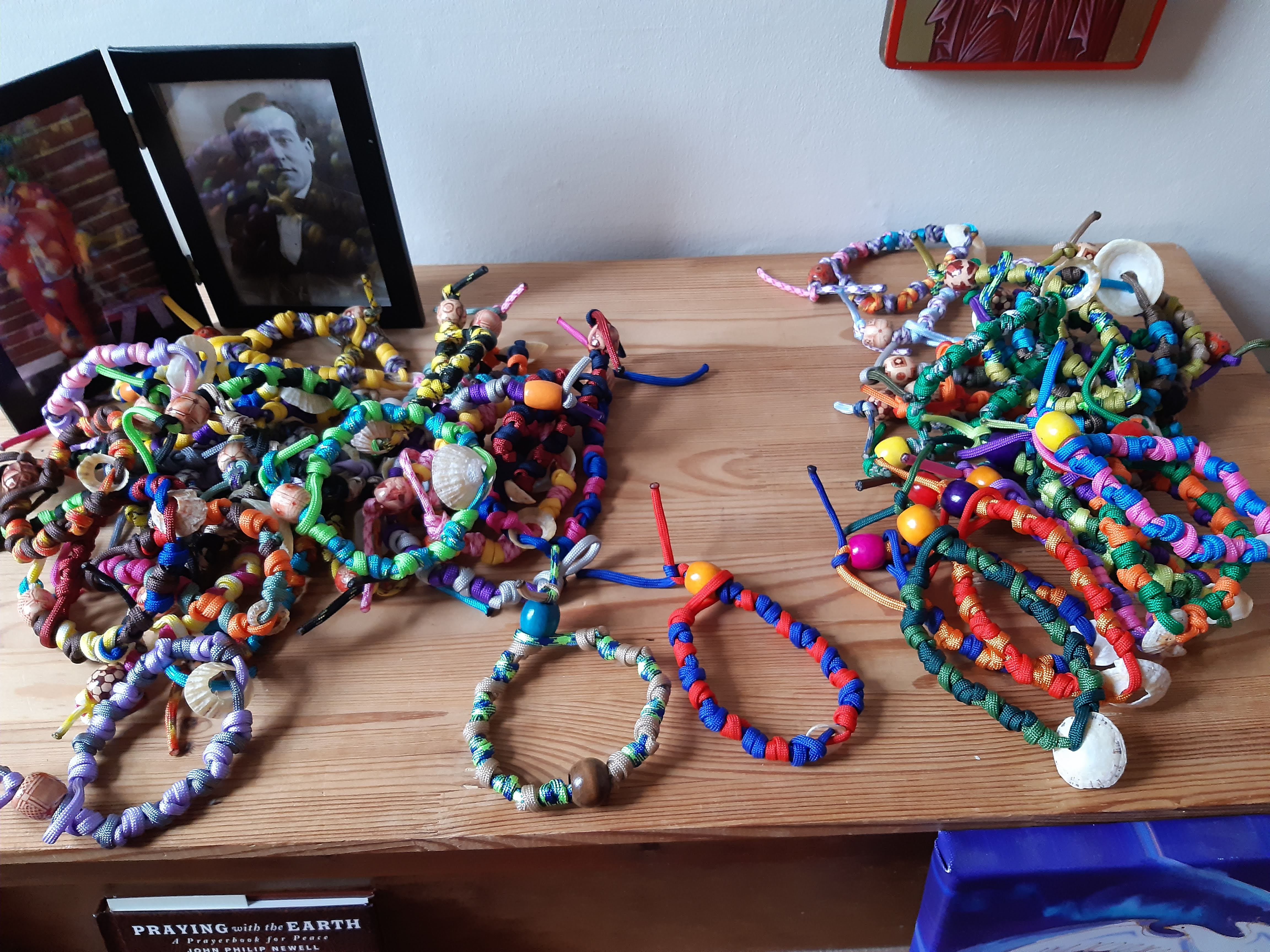
In some ways, wrinkles aside, I haven’t changed much. I spent the spring months this year knotting prayer bracelets to give to year 6 children in Bollington where I serve as a curate – to tell THEM that they are loved – by my church, St Oswald’s, by God. I wanted them to know …..as they headed off to the scary adventure that is high school….that prayer is more than words. And when words fail or beliefs fail you can still pray ….you can light a candle, you can hold a prayer bracelet and remember that you are loved, valuable and that there is help out there. I wanted them to know that they matter – to God, to the world, to St Oswald’s, to me.
At the beginning of July, my little prayer table at home was COVERED in prayer bracelets – and I and folks in the Sunday congregation prayed with every single one of them. The children recieved ‘pre-prayed-with’ prayer bracelets!
Now, my prayer table is a bit emptier – except I now have cards on it with the names of those we gave the bracelets to – because we are still praying for them.
One of the things I love about the Christian faith is that it is INCARNATIONAL – God becoming a body – a person. God saying that stuff – the stuff we humans touch and the kind things we do – are sacred and eternal.
That’s why we light candles in church – to put our prayer into a simple action. And in the service called Holy Communion we eat a tiny bit of bread and drink a sip of wine – to connect us to the infinite, to the eternal, to remind us that we matter to the living God.
I still like making stuff. I knot prayer bracelets. I write books. I blog a bit. Stuff matters. As do you. God bless.
I love donkeys. I love the gentleness of their faces. I love the way they symbolise the humilty of God. I love the legends that surround them. I love the fact that they have a cross on their back – the story of God’s pain drawn in the fur of a donkey.
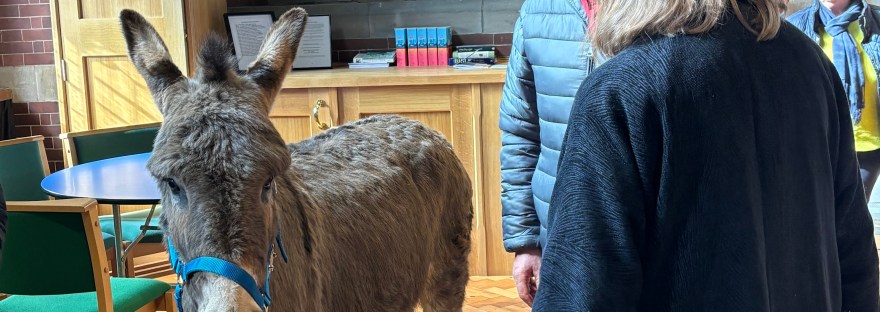
And on Sunday at St Oswald’s we had a visit from a donkey – from Barney the donkey, to be precise. And 40 excited children, 60 adults and one very excited curate got to encounter a living symbol of the humility of our God.
And earlier that morning, before the children and the donkey arrived and filled the church with joyful chaos, I had preached at a quieter service. And I preached on the story that starts off the Passion Liturgy – the nameless woman in Mark 14 who annoints Jesus’ head with perfume of nard.
And drawing on comments made by friends and colleagues in the week leading up to that sermon, I noticed how this woman gave Christ two precious gifts that are often overlooked. One was the gift of actually listening to him and believing him when he said he was going to die. Others around him, the high profile named characters in Mark’s gospel, James, Peter, John…they were in denial. Jesus said he was going to die and they said ‘not on our watch’ you don’t.
This woman looked and listened and saw a man going to his death. It is a gift to be seen. A gift to be heard. A gift to be understood. And it’s a gift she gave Our Lord.
And she annointed his hair with a whole bottle of nard. And when a friend said she had smelt a tiny bit of nard – and that it had filled a room with a clear, spicy, beautiful scent that lingered…I thought that Christ would still have been surrounded by that smell even while he hung on the cross. The memory of this unknown woman, her love and her understanding would have been with him on the cross. Another gift.
It is sometimes said that Christ was abandoned on the cross, to die all alone. I beg to differ. The smell of the nard was with him. His mother was with him. Mary Magdalene was with him. When people say ‘everyone’ ran away what they really mean is all the men ran away, all the important people ran away. Leaving the nameless ones, the unimportant women in the story and the unnamed Disciple whom Jesus loved, standing and waiting with him. Keeping Our Lord company. Giving him the gift of courage in not running away, the gift of waiting with him.
And by entering into the ancient story of Holy Week – whatever our beliefs or unbeliefs – even if only a tiny, tiny bit we join with the nameless ones, the unimportant ones who kept company with the God who rode a donkey. We give a tiny gift to the one who gives us everything.
Walking with Julian – All Shall Be Well (This blog was recently published as an article in Transforming Ministry Magazinehttps://transformingministry.co.uk/)
Meeting Julian
It was the priest who conducted my wedding, some 37 years ago, who first quoted Julian of Norwich to me. “All shall be well and all shall be well and all manner of things shall be well,” he said, to calm my pre-wedding nerves. I had never heard of Mother Julian before, the 14th century anchorite whose visions led her to write what we now know as the spiritual classic, Revelations of Divine Love. However that phrase was a doorway for me into her little cell that I have stepped through frequently over the years and still do today.
That phrase itself, perhaps her best known, was written by a woman living through the plague who may have suffered the deaths of her own children and had certainly suffered serious illness. She constantly ran the risk of being accused of heresy, both because of her sex and because of her radical theology. She was not, in some simplistic way, simply hoping for the best nor does this quote have much to do with the power of positive thinking. It is rather a marker of a deep trust in the kindness and what she calls the ‘friendliness’ and ‘courtesy’ of God. I used to text the phrase to my daughter when she was going through difficult times. It in no way diminishes the challenges of life but puts them into an ultimate perspective where everything that happens and all that exists is held, like the hazelnut of another famous passage, within the gentle and loving hands of God.
If a 14th century anchorite, living through the bubonic plague and the wars and violence and misogyny of that period, living in the midst of fear and death, could say that all will be well then I felt, and still feel, that her deep and radically optimistic theology was a resource to lean on.
A growing presence
Julian has also helped me, and countless other women too, to find some female aspect to the divine in a religion dominated by maleness. In the past 50 years, feminist theologians have raised awareness of the Bible as a document written largely, if not exclusively, for men and one that is full of sexism and misogyny in its portrayal of women. The most widely used metaphors for God – father, king, warrior, slave owner – in the Bible and in our liturgies and hymns, are not only male but patriarchal, assuming relationships of domination and violence.
And while the mostly male authorities of established churches acknowledge that God is beyond all gender and that the words we use for the divine are metaphors, this is often accompanied by a paradoxical instance that it is and will always be wrong to call God anything other than ‘Father’ or ‘Lord’.
The Church of England is just at the beginning of what I expect to be a very long conversation – indeed struggle – about the possibility of naming God as anything other than ‘Father’ and ‘Lord’ in our authorized texts. Sadly, I doubt I will see very much change in my lifetime.
And yet in the midst of that patriarchal context, dear Julian simply calls Jesus ‘our true mother’ and says that ‘the great power of the Trinity is our father and the deep wisdom of the Trinity is our mother’. And while scholars differ about whether Julian can actually be called feminist, she has certainly helped this woman to find her feminist voice.
As a feminist and an academic I felt – and feel – very outnumbered in the Church of England in my desire to name God as She, as well as He; in my belief that the Spirit is calling us, church and society, to move toward a diversity of ways of naming and imagining the Divine. At theological college recently I deeply shocked a dear colleague from a conservative theological background the first time I prayed aloud in the name of our Mother Jesus Christ! So it was a real comfort and, yes, joy to be able to gently share with him that I was NOT doing anything Julian hadn’t already done, many hundreds of years ago!
Female imagery for God is present both in the Bible and, as Julian reminds us, in our tradition but it has been largely overlooked. Some women decide that our established traditions are simply irredeemably patriarchal and walk away. As one of those who remain, as a woman for whom tradition, despite its failings, continues to have beauty and meaning and power, Julian is a great source of help and encouragement.
Lived experience
And Julian helps me find my feminist voice because she took her own female experience – and the female embodied experience more broadly – with the utmost seriousness at a time when only educated elite men were seen to be competent to teach or preach or to discuss theology. She uses the squalor and blood and dirt of the female domestic sphere to draw conclusions about the very nature of God. Claire Gilbert, whose novel I, Julian was published this year, (Byrne, 2023) notes how Julian’s frankness about experiences like constipation, helped her deal with her own drug induced constipation during cancer treatment. Julian’s is no squeamish, sanitized religion. She finds the presence of God in human soil and the soil of the earth and uses those experiences to show that God is not only kind but profoundly understanding, forgiving, nurturing and sustaining.
Julian is still cutting edge for feminist theologians in many ways. Having had her visions at a relatively young age, around thirty, she then spent the next 50 years mining those experiences for profound insights into the nature of God. Today, it is still normal for most theology to be written by elite white men and for their discussions of their experiences of God to be labelled theology while when women or lower status men write about their experiences they are labelled memoir or personalstory. Black women are leading the way in claiming the lived experiences of women as sources of theological reflection and others follow. Writers like Dolores Williams (Williams, 2013) and Eilidh Campbell (Campbell, 2021) build on the foundations laid by Julian of Norwich in giving to women like me the confidence to see ourselves as theologians too and to see the ordinary, messy but dignified struggles of real female life as windows into God.
As a teacher of the Alexander technique, an embodied movement-based contemplative discipline, I draw on Julian in my belief that learning more about our miraculous bodies and paying gentle, appreciative attention to the moment by moment sensations of simple movements, is both prayer and theological reflection. Such physical awareness teaches me and my students more about the Divine Reality that is expressed in and experienced only through our bodies.
A radical writer
In her introduction to the Penguin Classic Edition of Julian’s Revelations, (Spearing, 1998) Elizabeth Spearing makes the point that Julian wrote very much as a woman and this is part of why her work is so distinctive. Male writers had received classical educations based in Latin and rooted in competitive debate where there were winners and losers in argument – a kind of intellectual equivalent to medieval jousting where you learned a subject by fighting over it. This combative kind of writing is sometimes referred to as ‘agonistic’ and it is characteristic of both ancient classical cultures and our own academic traditions (Ong, 1974). This classical influence can be seen in the gospels, perhaps especially in John’s Gospel with its harsh denunciations of opposing views.
Julian, lacking a classical education, simply does not engage in that kind of argumentative writing and it is one of the most refreshing and for me, profoundly healing aspects of her writing. She does not argue for her views. She deeply and gently explores and presents her interpretations and leaves space for the reader to respond as she or he wishes to, as the Spirit moves us to. She is not interested in imposing her view as ‘the right one’ or in convincing her reader that any other view is therefore ‘wrong’. Today, feminist academics challenge the male conventions of combative academia and call for more relational, more creative ways of thinking, reading and writing.
Maggie Ross also notes that Julian uses subtle layers of meaning – Ross calls them ‘word knots’, where a single word can have multiple meanings and, crucially, ‘all meanings are meant’ (Ross, 2018, p. 22). Ross says this is one of the strategies Julian uses to do theology and it is a profoundly contemplative strategy. There is no grasping for a single meaning, a right interpretation or for control of how the reader responds. It is a widening of meaning, an apophatic opening of space for the reader/hearer and for the Spirit to work. Again, I see Julian as an ally and role model and both in my writing and in my preaching, my aim is always to leave space for other views, space for the Spirit to speak.
This contemplative mode of reading Scripture, has opened up for me difficult texts like John’s Gospel and indeed all scripture. There are always multiple readings present in any passage, many possible interpretations and, as Julian saw, ‘all meanings’ may be meant.
It has also provided me with a way to respond generously and with curiosity to other faith traditions, both Christian and beyond. So when I hear simplistic single meanings of Biblical texts used as weapons against vulnerable groups in society I find I turn to Julian and her word knots to wonder how else a text might be interpreted? She shows us, I think, a different and gently powerful way of reading and believing that does not need someone else to be ‘wrong’ so that I can be ‘right’.
Resting in God
One of Julian’s writings that I turn to most frequently is that on prayer. She says that ‘The best prayer is to rest in the goodness of God, knowing that that goodness can reach right down to our lowest depth of need’. I have experienced illness and disability in recent years and have at times struggled with low energy and exhaustion. That phrase constantly reminds me to stop trying so hard, stop trying to do prayer and just to rest, in stillness, in love, in the hands of our Divine Mother and Father and let go.
Julian presents us with a radical vision of God as female as well as male, a challenging willingness to take the reality of life – including women’s lives – as the stuff of theological reflection and a gently contemplative way of doing theology that moves beyond ‘right versus wrong’. Julian’s is a courteous, powerful, positive and above all kind vision of God that I think the world needs very much today.
Byrne, L., 2023. I Julian: The fictional autobiography by Claire Gilbert. Church Times , 6 4.
Campbell, E., 2021. Motherhood and Autism: An Embodied Theology of Motherhood and Disability. London: SCM Press .
Fox, M., 2020. Julian of Norwich: Wisdom in a Time of Pandemic and Beyond. Bloomington: iUniverse.
Llewelyn, R., 1980. Enfolded in Love: Daily Readings with Julian of Norwich. Fourth Edition 2004 ed. London: Darton, Longman and Todd Ltd.
Ong, W. J., 1974. Agonistic Structures in Academia: Past to Present. Daedalus: American Higher Education: Toward an Uncertain Future , 103(4), pp. 229-238.
Ross, M., 2018. Silence: A User’s Guide Volume 2: Application. London: Darton, Longman and Todd Ltd .
Spearing, A., 1998. Introduction and Notes . In: Julian of Norwich, Revelations of Divine Love . s.l.:Penguin , pp. vii-xxxiii.
Williams, D. S., 2013. Sisters in the Wilderness: The Challenge of Womanist God-talk. New York : Orbis .





 Jennifer Fox Eades: Alexander Technique Teacher