Uncategorized

Praying Creatively with St Francis’ Canticle of the Creatures

Most high, omnipotent good Lord (Our Kindest Grandmother Adored), To you be creaseless praise outpoured, And blessing without measure. From you alone all creatures came, No-one is worthy you to name.

My Lord (God) be praised by Brother (Sister) Sun, Who through the skies his (her) course does run, And shines in brilliant splendour. With brightness he (she) does fill the day, And signifies your boundless sway.

My Lord (God) be praised by Sister Moon, And all the stars that with her soon Will point the glitt’ring heavens. Let wind and air and cloud and calm, And weathers all repeat the psalm.

By Sister Water then be blessed, Most humble, useful, precious, chaste. Be praised by Brother (Sister) Fire; Cheerful is he, (she) robust and bright, And strong to lighten all the night.

By Mother Earth my Lord be praised; Governed by you she has upraised What for our life is needful. Sustained by you though every hour, She brings forth fruit and herb and flower.

My Lord (God) be praised by those who prove In free forgiveness their love Nor shrink from tribulation. Happy, who peaceably endure; With you Lord  (Mother) their reward is sure.

By Death our Sister praised be, From whom no one alive can flee, Woe to the unprepared. But blessed be those who do your will And follow your commandments still.

Most High omnipotent good Lord (Our Kindest Grandmother adored) To you be ceaseless praise outpoured and blessing without measure. Let every creature thankful be And serve in great humility.

The Canticle of the Creatures is a hymn that St Francis wrote near the end of his life. It expresses his sense of the profound sacredness and inter-connectedness of all creation. I love it and sing a version of it more or less every day, and have done so for nearly 15 years. And I do so – creatively. I quite deliberately play with the words. Because, like most God-talk throughout history and round the world and in all traditions (and all faiths) it assumes that the Holy is male and exclusively names God as He.

Which, at this point in my life and my spiritual path, I find …..unhelpful.

So, generally, I change the genders of Brother Sun and Sister Water – sometimes they are Sister Sun and Brother Water. Playing with the genders gently challenges the stereotype that men are always strong and in control and women are always gentle and pure!

I play with the opening.  ‘Most High Omnipotent, good Lord’ becomes  ‘Our Kindest Grandmother Adored’. Someone once asked me which woman ‘imaged’ God for me and I knew at once that it was my beloved grandmother. For me, God is not an omnipotent, royal male (God isn’t female either, of course, God is all genders and none). So I lean on that powerful, personal image in my own praying of the Canticle. In the version above my own adaptations are in bold type. You can make your own!

But I sing this version of the canticle while I walk, or run or cycle in God’s good creation.

I began playing with prayer creatively as a young mother of three children. To carve out time alone was sometimes, frankly, impossible so I learned to pray – with my children. I committed prayers to heart so I wasn’t reliant on books and I would sing or say my prayers with them as I went about the work of the day.

It was a very practical decision.

Years later, I committed the Canticle of the Creatures to heart so that I could sing it on my daily run, and still fit in silent prayer before breakfast, caring for my family, working part-time, studying and helping to lead a church. Again, it was a very practical decision.

Now I have more time available I continue to pray creatively, playfully – and now it is a theological decision. And the version I sing is a theoological decision, too.

Humans, made in the image of a creator God are creative at their core. It is never a question of ‘are you creative?’ but ‘how are you creative?’ And I suspect that most, if not all, people of faith are creative in how they pray and when they pray and where they pray. Yes, there is tradition and that can be beautiful and wonderful. And then there is how we practice that tradition – which will change each time we pray because we pray as embodied creatures whose bodies and lives and environments are changing moment by moment.

I have always prayed creatively but if I am honest I have often felt slightly guilty for doing so. Am I praying ‘properly?’ I have asked myself and even, ‘is this allowed?’ 

Now, I have spent 15 years singing about the Spirit of God incarnate in Sister Sun and Brother Water, Mother Earth and our Grandmother God. I have spent 15 years letting the words of the Canticle sink into my bones with each step as I have run, walked or cycled on our Mother Earth.

And after 15 years I am learning to let go of the guilt and to enjoy my God-given creativity. I am learning to accept that I really am a woman made in image of our creative Mother or Father or Grandmother God – and to be thankful.

Questions for reflection

How are you creative?

Is there an activity in your life you don’t currently see as prayer that you could see as prayer? How might that activity change if you did?

Can you learn by heart – and play with – a part of the Canticle?

A version of this article first appeared in Issue 26 of Little Portion, The Magazine of the Third Order, Society of St Francis, Spring 2025.

My book, Embodying Prayer (2024) is published by Christian Alternative Books

Uncategorized

A woman of peace

This has been a week when the world has felt full of angry voices and violent actions. It is a week when those of us who work for peace and kindness and care in our world and in our church have been shocked anew by stories of violence and abuse.

It was a week when, bruised and bewildered by the news of my church’s shame, I wondered what on earth I could say to an assembly full of beautiful children and their equally beautiful hard working teachers.

And as I knelt, early on Wednesday morning, in front of an icon of St Clare, it shone in the light of my candle and I knew what I wanted to say. I knew how I wanted to be. So let me tell you her story……

“Clare was a woman of love, a person of prayer and a person of peace. And she always remembered that she followed Christ, the Prince of Peace.

But the times she lived in were not peaceful times. Men of war, men of violence, meant that life was often dangerous for ordinary women and children and men.

And a story is told about St Clare of how, one day, an army of violent men came to attack the little town of Assisi where Clare lived.

And instead of running away and instead of fighting back, St Clare remembered that she followed Christ, the Prince of Peace. And she went into her little church and brought out a  box. And in that box there was a small piece of the bread and a tiny drop of the wine that Christians eat and drink when they remember Christ, the Prince of Peace.

And Clare held that little box and she just stood – and remembered. She remembered all the women and men and children in the town of Assisi. And she remembered Christ, the Prince of Peace. And she remembered that the men of war she could see before her were also children of God.

And on that day, for some reason, the men of war turned back. Some people say they were scared of this little godly woman. I’m not so sure. I think that on that day they, too, remembered peace and remembered that they were children of God. And I think they chose – and it is always a choice, to stand and remember peace and love for themselves.”

So today, sisters and brothers, (and everyone, of any faith, who is reading this IS my sister and my brother) in the face of the violence and injustice and sheer nastiness that can happen in our world I invite you to stand – not to flee and not to fight – but simply to stand for peace, to stand for justice and love and kindness and compassion. And please remember that you – and everyone you meet today – is an infinitely precious child of God.

May She bless you and may She keep you and may She give you Peace.

Prayer, Spirituality, theology

Donkeys, nameless women and unnoticed gifts – thoughts for Holy Week

I love donkeys. I love the gentleness of their faces. I love the way they symbolise the humilty of God. I love the legends that surround them. I love the fact that they have a cross on their back – the story of God’s pain drawn in the fur of a donkey.

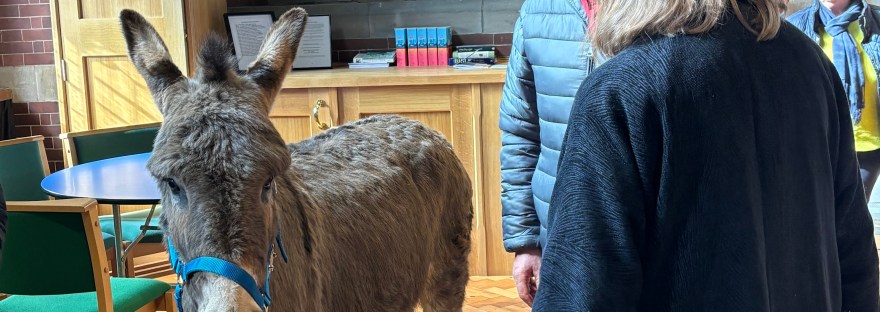
And on Sunday at St Oswald’s we had a visit from a donkey – from Barney the donkey, to be precise. And 40 excited children, 60 adults and one very excited curate got to encounter a living symbol of the humility of our God.

And earlier that morning, before the children and the donkey arrived and filled the church with joyful chaos, I had preached at a quieter service. And I preached on the story that starts off the Passion Liturgy – the nameless woman in Mark 14 who annoints Jesus’ head with perfume of nard.

And drawing on comments made by friends and colleagues in the week leading up to that sermon, I noticed how this woman gave Christ two precious gifts that are often overlooked. One was the gift of actually listening to him and believing him when he said he was going to die. Others around him, the high profile named characters in Mark’s gospel, James, Peter, John…they were in denial. Jesus said he was going to die and they said ‘not on our watch’ you don’t.

This woman looked and listened and saw a man going to his death. It is a gift to be seen. A gift to be heard. A gift to be understood. And it’s a gift she gave Our Lord.

And she annointed his hair with a whole bottle of nard. And when a friend said she had smelt a tiny bit of nard – and that it had filled a room with a clear, spicy, beautiful scent that lingered…I thought that Christ would still have been surrounded by that smell even while he hung on the cross. The memory of this unknown woman, her love and her understanding would have been with him on the cross. Another gift.

It is sometimes said that Christ was abandoned on the cross, to die all alone. I beg to differ. The smell of the nard was with him. His mother was with him. Mary Magdalene was with him. When people say ‘everyone’ ran away what they really mean is all the men ran away, all the important people ran away. Leaving the nameless ones, the unimportant women in the story and the unnamed Disciple whom Jesus loved, standing and waiting with him. Keeping Our Lord company. Giving him the gift of courage in not running away, the gift of waiting with him.

And by entering into the ancient story of Holy Week – whatever our beliefs or unbeliefs – even if only a tiny, tiny bit we join with the nameless ones, the unimportant ones who kept company with the God who rode a donkey. We give a tiny gift to the one who gives us everything.

May your Holy Week be blessed.