Author: Dr. Jennifer Fox Eades
Prayer, social justice and children
A reflection inspired by the following passages….
‘All shall be well and all shall be well and all manner of things shall be well.’ Julian of Norwich
‘The best we can accomplish for posterity is to transmit unimpaired and with some increment of meaning the environment that makes it possible to maintain the habits of decent and refined life. Our individual habits are links in forming the endless chain of humanity…we can retain and transmit our own heritage only by constant remaking of our own environment’ (Dewey, 1922, p. 13)
‘People were bringing even infants to him that he might touch them; and when the disciples saw it, they sternly ordered them not to do it. But Jesus called for them and said, “Let the little children come to me, and do not stop them; for it is to such as these that the kingdom of God belongs. Truly I tell you, whoever does not receive the kingdom of God as a little child will never enter it.’’ (Luke 18, 15-18)
‘Very truly, I tell you, unless a grain of wheat falls into the earth and dies, it remains just a single grain but if it dies, it bears much fruit. Those who love their life lose it, and those who hate their life in this world will keep it for eternal life.’ (John 12, 24-25)
The Third Order: Doing things in threes
I am a member of the Third Order of the Society of St Francis, or TSSF, which means that I try to follow Jesus Christ, after the example of St Francis and of St Clare, who was Francis’ close friend and guide. At the heart of Francis’ life there was a tension which reflects a tension many of us experience, that of the balance between inner work or contemplation and prayer and outer work or activism. This lived out tension was one of the things that attracted me to the life and example of Francis and to the Third Order. And I draw on the example of St Francis as I try to live out a commitment to social justice in my home, in my work and in my church.
An underlying theme behind the work that I do, and behind my home life and my spiritual life has always been well-being and in particular the well-being of children and young people and those who care for them. In work, home and church I try to create an environment in which people, old and young, can be well – and can experience the Divine, the source and giver of Wellness.
In the Third Order, we do things in threes. We have three aims, three pathways to achieve those aims and three key notes. Our three aims are firstly, to share the love of God in Christ as we understand that; secondly, to spread a spirit of love and harmony– or to work for social justice – and the breaking down of barriers between people; and finally to live simply. The three pathways through which we try to achieve those aims are work, study and prayer. Our three keynotes are love and joy and humility, and without these three characteristics or graces, we believe we cannot achieve our aims.
We are not all required to pursue all the aims equally or to practice all of the pathways to the same extent. Each person finds their own balance in their own particular circumstances and across our community overall we hope that we will also achieve balance.
Social justice in education: our cultural view of children
My own particular interest and focus in thinking about social justice is in the area of adult/child relationships and how children are viewed in our society. I have worked with children and young people throughout my life and I have been a parent for 27 years. And I think that, culturally, adults in Britain have a problematic relationship with children. Both in the way that we educate children and in how we parent children our attitudes often seem to me to be characterised by injustice and by a lack of love, joy and, indeed, humility. In Britain we tend to either idolize and worship our children or demonise them. On the one hand we can worry too much about our own children, paying them excessive amounts of attention and letting them dominate our lives and thought and hopes. On the other hand, encouraged by the media, we can see them as problems, as ‘feral’ or simply as ‘terrible twos’ or ‘terrible teens’ respectively. We focus on what children lack, on what they cannot do or cannot do properly.
I think that this view of children and young people as a ‘problem’ and somehow ‘lacking’ rather than as fellow travellers and full and unique human beings can lead to unhappiness for all of us and to a lack of mutual respect.
One of the quotes above is from the philosopher of education, John Dewey, an American professor writing in the 1920s. Dewey is an interestingly radical philosopher. His views of education are still regarded as dangerous and subversive by politicians of the right and the left and he is alternately demonized and idolized by politicians and by educators, almost none of whom know anything about what he actually said.
But what he said WAS radical and I think it was profoundly influenced by a deep commitment to social justice. Two of his ideas are particularly important to me and underlie how I see children and how I have tried to parent and to work with children. One is that we never educate directly, only indirectly – we create the environment in which learning takes place. The second is that true learning is mutual – I learn from YOU as you learn from ME and we are both changed by it. And what is particularly radical about Dewey is that he applied those principles equally to children and to adults – he didn’t think that children are, so to speak, a separate species to be educated and treated in a way that is radically different to how adults should be educated or treated. So he didn’t start, as I think our education system largely starts, from a sense of what children LACK or CAN’T do, but from a sense of what they already know and can do. He thought children could think for themselves and had views and experiences worth paying attention to.
When I first worked with 4 year olds at the start of my career, as a very young teacher, I hadn’t read John Dewey. But I did have an instinctive sense that children were worth taking seriously. I very much treated my class of 4 year olds the way I would have treated a class of adult learners – though we perhaps had more fun sometimes – and the children, for the most part, behaved accordingly. Yes, sometimes, everything went pear shaped but mostly they responded to being given responsibility, trusted, listened to, treated with respect by behaving responsibly, being trustworthy, listening to me and being respectful. In other words, usually they behaved with and showed an immense maturity that all too often they are seen as incapable of showing.
I tried to create a safe, respectful, stimulating environment and took what I now realise was a relatively humble view of my own ability to directly TEACH them anything and a correspondingly high view of their ability to learn and for me to learn from them. I studied the Lion the Witch and the Wardrobe with my 4 year olds when they were all watching it on TV, ignoring the horrified comments of my colleagues that ‘they wouldn’t understand it’. The comments I overheard in my play area/White Witch’s Palace showed me they understood it perfectly. And I quote, ‘If YOU don’t do as you’re told I’LL turn you into stone!’
That was one simple way I tried to put into practice what I would now see as a commitment to social justice. Later in my advisory work with schools I deliberately used democratic teaching methods with younger teachers, such as P4C, or community of enquiry. This is a dialogue based teaching method which involves respectful listening and requires the teacher to listen as much as the children. And I used oral stories and storytelling – another democratic teaching method. When we tell an oral story the meaning or interpretation of the story is not imposed on a listener, whatever their age. Rather the listener creates meaning for his or herself and interprets what they hear in the light of their own lived experiences. It is why all of our great faith teachers told stories and left us to work out what they mean – to us.
Social justice in the home: learning from our children
When I had children of my own I consciously tried to take these principles of equality and mutuality into my parenting. As a young parent I read a book by the contemplative Christian writer Henri Nouwen, who said that children were the most important guests we would ever have. And that phrase stayed with me. I was a far from perfect parent as my children would be the first to say. But I did always at least try to make the space to listen to my children, to treat them, fundamentally as equals, and to be willing to learn from them and to be changed by them. I always apologised when I got it wrong and aimed to create a hospitable, loving environment in which they could learn, in which they could be well. That willingness to be changed by my children is even more important to me now that I am aging. I find myself very deliberately asking my young adult children to challenge my thinking, particularly in the fast moving and changing arena of gender and sexuality. The temptation as we age is to cling to the past and to narrow in our thinking and it is listening to the prophetic voice of the young that can help us resist that temptation.
Children in church?
I attend an Anglican church. And it seems to me that the Church of England, by and large, tries to educate its children about the Christian faith the way that our state education system educates our young about history and chemistry. The traditional Sunday school model separates children from adults, older children from younger children and, I think, defines children by what they LACK, seeing them as potential Christians – not by what they already ARE, which is children of God with a knowledge and experience of God to share with us. There is a tendency, even in churches, to see children as a problem.
When the children go out the back and leave the main service, as they sometimes do in my own church, I feel that we are diminished as a community and I feel it as an injustice. And while the injustice is being done to both groups, since both groups suffer by it, children are not in a position to challenge or change the system and adults, at least some adults, are.
But what I propose as an alternative is NOT going to win me any friends! If the children stay IN the service, and even play a full part in that service, the children won’t necessarily thank me for it. They won’t thank me because they will have to learn to respect the adults’ needs for occasional order and quiet, to listen to stuff that may seem quite boring at times and NOT run around yelling, as they can now, or playing with the toys out the back. And that will require effort on their part. And some of the adults won’t thank me because the children will bring noise and disruption into our nice quiet ordered worship and they may perform their leadership roles, if they are given them, imperfectly. And accepting that will take effort on OUR part. The easy option is to carry on as we are.
But is the easy option, when it comes to the life of faith, the one to take? I question whether it is. I question it partly from a pragmatic view point. It is the case that a large number of children who go through that traditional ‘children out the back’ model of Sunday school give up on church when they reach their teens. And I am not surprised. While they were ‘out the back’ they were not being given responsibilities, listened to, engaged with as equals, as fully ‘children of God’ – so they were not really fully part of those churches and never learned to ‘be’ church for themselves. And if you are not a full part of a community why would you continue attending once you have the freedom to choose for yourself?
But mostly I question the wisdom of the easy path from a social justice view – we need children to be fully part of our communities of faith so that we can listen to them, learn from them, be changed by them and so that they can learn to listen to, learn from and be changed by us. And that may – it almost certainly will – be messy, disruptive and uncomfortable. As is perhaps appropriate in the life of faith. But we need our children to become, as Dewey says, links in the endless chain of humanity. Just like us. So that all of us may be well and all may be well and all manner of things may be well – for all of us. Our children may be small links, short links, but they are important links all the same.
Holy Bible, New Revised Standard Version. Oxford : Oxford University Press.
Dewey, J., 1922. Human nature and conduct. 2012 ed. Online Publisher: Digireads.com Publishing.
This post is based on a talk given on April 7th 2018 at the ‘Responsible Stewardship for our Times’ Event organised by Rumi’s Circle
Prayer, the body, the Alexander Technique and bad backs
What’s your body got to do with prayer? Isn’t it the soul that prays, anyway??
Over the years – and in different traditions – the way we stand or sit or kneel to pray has changed and some would say it doesn’t much matter what our bodies are doing when we pray. But perhaps it does matter and perhaps thinking about how we stand or sit or kneel might even deepen and enrich our prayer lives. 
The bible has a lot to say about bodies. In the Old Testament, when the people of God ignored God’s law it says, ‘They turned a stubborn shoulder and stiffened their necks’ (Nehemiah 9. 29). The psalmist exhorts ‘Do not harden your hearts’ (Ps 95) and tells us to ‘Stand in awe’ (Psalm 4) and ‘Lift up your hands in the holy places and praise the Lord’ (Psalm 134).
The Alexander technique also has a lot to say about bodies. Many people, myself included, first encounter it because it can help to ease or prevent bad backs. And happily, after a few lessons, my bad back got a lot better, But what made me carry ON having lessons was noticing in myself psychological and emotional changes – I felt calmer, less likely to over-react to situations. I decided to train as a TEACHER of the Alexander technique – which is a 3 year full time training – at least partly because of the psychological – and spiritual – depths it seemed to offer. And also because it is undoubtedly a good way of helping other people with bad backs!
The Alexander technique, which has been around for over 100 years, was first seen as a voice or breathing technique and only later became associated with the relief of chronic back and neck pain. Really, it is about the WHOLE of you – body, mind, emotions, spirit – and how you do the things you do every day – how you ARE in the world. As you become more aware of how you do the things you do, you also become more able to keep calm and think and notice and choose how to respond to the things life throws at you.
Which brings me to the body and prayer. Prayer is sometimes called ‘paying attention’ (Simone Weil) – paying attention to God, to what is really there. In the Alexander technique you learn to pay attention to your usual patterns of thought, movement and behaviour – and gradually to notice what is really happening. And you can learn to press the pause button, to quieten down and choose not to move carelessly, not to react without thought, not to get drawn into endless rumination.
All of these are skills we can use in prayer. In prayer we are choosing to open our eyes rather than to close them, to open or soften our hearts rather than to harden them. We can choose to give ourselves permission to let go – of unwanted thoughts, of unnecessary tension. And we can choose to pay more attention to ourselves and our bodies, which God has created and which God delights in. When I teach the Alexander technique, either in 1:1 lessons or in groups, my underlying aim is always for people to enjoy their bodies – and their lives –their whole selves, a little bit more.
Learning the Alexander technique has certainly changed how I pray. I now tend to keep my eyes open, rather than to close them, as it helps me stay alert and tuned into the world and myself. St Francis prayed that way too so I am in good company! I vary the position I pray in. When I notice tension creeping in I allow myself to let it go.
So, is there a right way to pray, physically speaking? In terms of position, no. We can pray in any position at all – lying, standing, sitting or kneeling. If you are tense or uncomfortable, however, then it matters because YOU matter.
Here are some ideas to play with to deepen your awareness of your body while you pray:
- Consider whether your posture suits the kind of prayer you want to practice. If you are engaged in confession, a position with bowed head might be suitable. But is it as suitable for praise? Or for thanks giving?
- Play with different positions for prayer and consider introducing more variety into how you pray.
- Pray while moving, walking, bread making or dancing even! I have learned some prayers to say by heart so that I can say them while running in the hills in the morning.
- Notice tension in your body as you pray and just give yourself permission to let it go.
- Ask God for a soft, open heart. What might that actually feel like physically?
- Smile when praying – it lifts the spirits and softens the heart
- Try praying with your eyes open – like St Francis – so that you can enjoy God’s creation
Fundamentally, consider how you treat yourself, in body, mind and spirit. Jesus told us to love our neighbour as ourselves. So that means treating our neighbour – AND ourselves, ALL of ourselves – with consideration and respect.
As well as being an Alexander Technique teacher, Jenny is also a member of the Third Order of St Francis and part of a lay leadership team in in the Church of England.
New book chapter
I am very pleased to say that I have just had a chapter published in this new book on positive psychology. It is co-written with Judith Gray, formerly head of Frodingham Infants and details the work we did together on Celebrating Strengths.
Celebrating Strengths combined ideas from positive psychology with psychodynamic theory and theology and philosophy to create what I think was a unique educational philosophy and approach to school life – and Judith was an important part of that process.
Character Strengths in the classroom
A discussion of practical ways to build character strengths and virtues into classroom practice Character strengths and virtues in the classroom – practical suggestions
Character strengths and virtues in education – how and why?
In my latest video I talk about how and why you might want to introduce character strengths and virtues in education. There are three main reasons – to help to manage or contain anxiety, to build relationships and to help teachers and students alike to stay hopeful. And I break all the good rules of talks by adding a fourth reason – it gives us a language to discuss – not to impose – ideas of right and wrong and what constitutes a good life.
The Elephant and His Mother
This is a version of one of my favourite stories – a story of love, wisdom and kindness

The importance of joy and pleasure in education
Today, I have been working on my PhD. And as a result of my reading and writing today, what is uppermost in my mind is the importance of pleasure – the simple pleasures of teaching, learning, writing, researching – and just living. I feel that pleasure in learning, what Simone Weil called ‘joy in the work’ is in danger of being eclipsed in all the talk of targets, improvements, standards etc.
Weil wrote that the intelligence only grows and bears fruit in joy. If she is right and I think she is, then much of what happens in schools today is not about growing intelligence. If teachers feel no joy in teaching, children are unlikely to feel much joy in learning, and if children don’t feel that joy in learning, that thrill of discovery, that freedom to try and to fail and try again, they will want to leave education as quickly as possible instead of seeing learning as a delight to pursue throughout their lives.
And today, I have felt joy. Joy in standing at my desk (I stand to work, sit down to rest); joy in reviewing the videos of my conversations with colleagues and pupils. Joy in the fact that I have the time and the energy and the mental space to write a PhD. Joy in the sunshine of a spring day in my study.
Interestingly, this joy does not preclude struggle or discomfort. I struggle to express my ideas clearly, feel anxiety about whether my work is of the required standard, get frustrated at trying to sort out a muddle of an over-long chapter into two tight, well-argued and interesting ones. There is dis-comfort in learning, too and it can sit, strangely enough, alongside the joy, even deepening it.
And what about the simple joys of standing, sitting, breathing, looking that my training as an Alexander Technique teacher has opened my eyes to? Those are there in the classroom too – but mostly, we’re too worried about targets and goals to notice. And that seems really rather sad. So now, I will end a day’s reflections with the joy of a walk in the sunshine. And, if you read this, I wish you a drop of joy too.
Weil, Simone. (1959) Reflections on the right use of school studies with a view to the love of God London: Fontana Books
Character strengths in action: Using your whole body to tell a story
You can, and I do, often use simple props to tell a story. You can also use your body. A mixture of tai chi moves, with signs from British Sign Language help me, as the storyteller, to embody the story. Because I am using my whole body, I am fully present, aware of where I am, my audience and my whole self as I tell the story. It is less a cognitive and verbal activity, than a way of inhabiting the story and drawing my listeners into the story with me.
I demonstrate this method of storytelling here
As well as the character strength of #wisdom, students see many other strengths in this story, including #humour, #persistence, #teamwork and #spirituality.
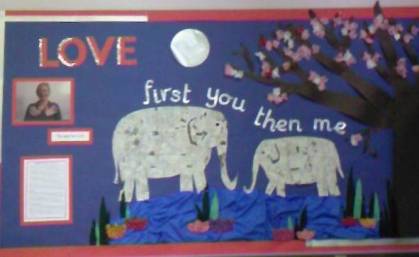
Here’s a picture from Frodingham Infants that is based on the story,

I hope you enjoy it 🙂
Three ways to develop character strengths and promote educational well-being
In these blogs and the videos that accompany them I am sharing with you what I have learned from 12 years of working in schools supporting the well-being of teachers and students.
The blogs and videos are meant either as a stand alone training resource or as a supplement to my published resources and my story videos.
In an earlier film, I talked about how I have put stories and storytelling at the heart of my well-being work in schools – precisely because a good story well told promotes the well-being of both teachers and students, An introduction to my well-being in education videos.
Now I want to talk about another theme, that of paying attention to character strengths and virtues.
I first came across the idea of character strengths in the work of Martin Seligman and the VIA or Values in Action character strengths and virtues. You can find more about this approach at the VIA Institute .
Of course the association of character strengths with education is much older and dates back to Aristotle. Aristotle linked happiness with the use of character strengths and virtues. And he said that children learn about qualities like courage and honesty in three ways
- seeing them used by role models
- thinking and reasoning about them
- using them for themselves
So we learn what courage is by being brave.
In my work, I’ve tried to draw on those three ways of learning.
Firstly, I’ve encouraged teachers to tell stories that show characters or historical figures using – or failing to use – qualities like love or friendship or enthusiasm. I might tell a story like Anansi and the Pot of Wisdom or Where is the Moon or the Three Little Pigs and then ask, what strengths did you see in that story? Where? I might also ask, were there character strengths that SHOULD have been used but weren’t?
In this way, children and teachers engage in a thoughtful – and educational activity – and at the same time begin to build up a picture of what the strengths look like in action and to listen for, look for the strengths, to spot them both in stories and then in other people and finally in themselves. Using character strengths for yourself, seeing them in others, thinking about them, builds positive relationships in the classroom and creates an atmosphere that enhances learning and supports well-being.
To develop Aristotle’s idea that we learn about character strengths and virtues through reason, I have used Philosophy for Children or P4C and taken either a story or a single word like creativity or courage as a stimulus for discussion. If you don’t know about philosophy for children there are resources and training available and the more I use it the more powerful a teaching tool I think it is. Again, a philosophy session is a very educational activity – we’re not trying to be therapists, we are encouraging intellectual rigour, depth of thinking and discussion. At the same time you as a class are building your understanding of what a particular character strength means in this group and in this community, now. It’s not what the ‘experts’ say about courage that really matters – it’s what it means in your school, your family, now that is important.
Finally, the third way of learning about character strengths that I have used in education is to create a concept of Strengths Builders – ideas and classroom exercises that deliberately set out to let you use and therefore build a particular strength. So, for example, if you want to focus on building the strength of curiosity for yourself or your class, you might set a challenge trying a single new food you have never tasted in the week ahead, or of watching a television programme or film you haven’t seen before – or of reading and even learning by heart a poem by a poet you have never read. You set out deliberately to pay attention to – and build – a particular strength. Then, if everyone in the class has done this activity – you can share and reflect on your experiences.
The shared experience – and the way that you are all paying attention to the same thing – curiosity – is part of what builds community. I will say more about community building in a future video.
If you want lots of ideas for building character strengths you can find them in my Character Strengths Ideas Box Character Strengths Ideas Box or in Character Strengths for Circle Time.

You can find a high school programme that contains strengths builders for all the VIA Strengths here Strengths Gym – a high school programme of strengths builders and stories for 11 to 14 years
Equally, you can think up your own.
Have fun.