Prayer, Spirituality

Seeing the Sacred….in a hip operation

(10 minute read)

I heard someone say that the work of a priest is naming the Holy. I liked and remembered that. If I can see – and name – the sacred in the everyday, and in my own life, then perhaps, in a tiny way, I can make it easier for others to see the sacred too, in their own lives and in the lives of those around them.

For centuries the task of naming – and indeed controlling – what counts as sacred has been the work largely (though not exclusively), of elite men. And elite men have reflected on and named as universal their own experiences of God. And this continues to this day.

There are female voices that have come to us from across the centuries but they are few in number, women like Julian of Norwich or Hildegard of Bingen, who widened the kind of experiences claimed as holy and therefore our understanding of what Sacredness means.

Today more voices are claiming their own experiences – their black experiences, their queer experiences, their disabled experiences, their refugee or living in poverty experiences as events where Sacredness happens, where the Spirit is at work. And that means that our sense of what words like ‘God’ mean can, potentially, widen all the more.

So I follow in that tradition by reflecting here on my own experience as a site of the Sacred. And in particular, and in common with other women theologians, I reflect on my own embodied and very physical experience as the place where I encounter the divine. And my everyday embodied and very physical experience recently has involved ….having an operation for a new hip. I have been experiencing bodily aging and fragility, pain and helplessness…. and then the gradual return of health and strength and ease of movement. And for me the question is, how is that sacred?

And firstly, I want to say it is sacred precisely because it has been a physical experience. Centuries of male theology, following Plato, has wanted the sacred to be purely transcendent, purely disembodied spirit, somehow beyond this messy, ordinary life, these imperfect, frail, beautiful bodies. I was undergoing a physical procedure, a medical experience, yes. But I felt profoundly that it was, at the same time, a spiritual experience too.

We only experience the world and God in and through our senses. My Christian tradition says that the Divine nestled in a woman’s womb, walked around, ate, drank, partied (went to the toilet), wept, suffered, died. And the doctrine of the Resurrection of Yeshua, Mary’s son, takes all of that human, wonderful, messiness back into the heart of God and says that it’s the stuff of eternity.

I certainly found myself preparing, very physically, for my hip operation – a little as I remember ‘nesting’ before childbirth – physically preparing the house, clearing space in my study, picking up trip hazards, sorting out and giving away unread books, recycling lecture notes. I felt I was approaching a liminal moment, a before and after experience, and I wanted to create space for that – physically and emotionally and spiritually.

Post-operatively, the physical experience of being ‘off balance’, of not being able to use one of my legs for the first time in nearly 60 years was deeply frightening and unsettling. So at that point I experienced a very physical helplessness and had to, very literally, lean on the kindness of strangers – on the medical staff in the hospital. On the kindness of friends and family, on my husband especially. I had to let go of independence for a while and ask for help, physical help and, indivisible from that, emotional and spiritual help too.

Now as mobility and balance return, I feel a deep physical relief and joy and simple awe at the miraculous – and spiritual – healing properties of the human body.

And I am conscious that this healing is a miracle, that it is grace, pure gift. I don’t make my body heal – it just does. I haven’t somehow earned my hip replacement – throughout history and round the less developed world still, people have to live with the debilitating pain that was my reality just a month ago. So I experience my operation as a sacred gift.

And it is one of the many gifts I have received through this experience. The deeply professional kindness of doctors, nurses, health care assistants was deeply healing. Likewise my dear husband’s kindness and that of the rest of my family and friends. Flowers, cards that arrived unexpectedly. A hip replacement has become routine but it wasn’t routine to ME and I have been so moved and grateful at being thought about, and cared for and prayed for.

And I have received the sacred gift of time in which to heal and the gift of permission to care for myself, for my physical, fleshy self and to prioritize my own needs – something our society grants to women, and perhaps mothers especially, all too rarely.

And it has been an experience of wanting to explore Spirit, to experience God, as female, too. Theologians like Elizabeth Johnson have been calling, for years, for the importance of naming God as She as well as He. And I found myself needing that gift more than ever through this time. Usually I just gently push  back at the near exclusively male language for God in our scriptures, sometimes cheerfully, sometimes crossly, quietly and internally changing many of the ‘He’s’ to ‘She’s’, the ‘Lords’ to ‘God’. But through this experience I just didn’t have the energy for that. So I ordered a copy of the Inclusive Bible from my hospital bed and have simply loved being able to read without having to do the substitutions. Someone else had done the work for me and I could thankfully lean on that gift, too.

Johnson says that the Spirit (which in both Hebrew and Aramaic IS linguistically female but is often not translated as such) has always been associated with creativity, with healing, with the movement of God in the world, with care and labour and beauty and liberation. And I have played creatively with my prayers during this time. I have linked my daily exercises with the beautiful, and for me very female, Angelus prayer, so that my exercise becomes prayer and my prayer becomes exercise – my body/spirit finding strength together.

I cultivated beauty in my prayer space and, to help myself cope with the sense of fear and instability I felt early on, I physically wrapped myself in my late mother’s care, wearing a jumper she knitted me and rubbing lavender oil, her favourite scent, into my bruised and battered leg. I lit candles and prayed the rosary by warm comforting light during wakeful nights. I let myself stop worrying about my weight, a lifelong struggle, and ate the nourishing food I craved. I wore clothes and jewellery that were not only comfortable but lifted my spirits because of their colour or links to people and places I loved.

Elizabeth Johnson says, of the Holy Spirit, ‘She is life, movement, colour, radiance, restorative stillness….she purifies, absolves, strengthens, heals…She awakens mighty hope…and this is the mystery of God, in whom we live and move and have our being’ (Johnson, 1992, 2020, p 135.).

If the Spirit is about healing, then this entire experience, the extraordinary skill of the medical profession, the kindness of family and friends, the physical pain, the fear, the need for my mum’s touch, the exploring of creative, female prayer have all been the work of that same Spirit. Psalm 143 prays ‘Let your nurturing Spirit guide me on a safe and level path’. That has been my daily, lived and very physical experience.

In a rather wonderful passage in the book of Ecclesiasticus, (also called Sirach) in the Jewish and Christian scriptures, we are told to ‘Give physicians the respect due their services …Their skill was given to them by God’ and, when ill, advised ‘Pray to YHWH….Then call your physician’ (Ecclesiasticus 38). I think there is a wonderful balance there. Our more secular society wants to split the physical from the spiritual, the medical and scientific from the Holy, the Sacred. I have found throughout this experience that I have wanted to put them back together, where I feel they belong.

Johnson, Elizabeth, (1992, 2020). She Who Is: The Mystery of God in Feminist Theological Discourse. The Crossroad Publishing Company

Prayer, Spirituality, Storytelling, Well-being in education

An Epiphany Celebration – for families or schools 20+C+M+B +24

This can be a gloomy, decorations down, back to work/school in the dark time of year. But, celebrating is GOOD for us and the more we do, the better we feel.

So, why not, as you take down the tinsel and cards, celebrate Epiphany, which is when the Magi, (wise men – or women!) actually arrive in the Christmas story?

You could: Bake an Epiphany Cake – google it and you’ll find lots of recipes.

And/Or hold a little ceremony and Chalk the Door as a house/classroom blessing and an expression of hopefulness for the year ahead?

The custom of chalking the door is an old Epiphany custom, one that is still used and is growing in popularity again.

So, 20+C+M+B+24 – The 20 and the 24 refer to the date, the + to the Cross of Christ and the C M B EITHER represent the traditional names of the Magi, Caspar, Melchior, Balthazar OR Christus mansionem benedicat – Christ bless this house.

So, why not…..

Celebrate Ephiphany by reading the story of the Magi from Matthew’s Gospel, Chapter 2 and chalking your door or the door of a friend or relative. Teachers, you might process around your school and chalk every door you can find!

Here’s the reading…

“After Jesus’ birth, Wise Men from the east came to Jerusalem. They asked, “Where is the child has has been born to be king of the Jews?…..King Herod sent them to Bethlehem…The star they had seen when they were in the east went ahead of them. It finally stopped over the place where the child was….

The Wise Men went to the house. There they saw the child with his mother Mary. They bowed down and worshipped him. Then they opened their treasures. They gave him gold, incense and myrrh”

Then Chalk 20 + C+ M+B+24 (in any colour) and say, if you wish,

God is love. The infant Christ was born as God’s love on earth. Christ dwells within each loving person, each loving act.

May God dwell in us and in this house/classroom in 2024. May She/He bless us richly and may we be God’s blessing to others. Amen

And you might talk before or after about your hopes as a family/class for 2024 – personal or as a community.

And THEN eat more gold coins……….and cake!

With thanks to Mark Earey at the Queens Foundation, Birmingham, https://www.queens.ac.uk/ for this idea.

Prayer, Spirituality

Being human, well….

Given the coverage of the Lambeth Conference in both church and secular press in recent weeks I have decided it is time to say clearly and simply that I am an ordinand (trainee priest) in the Church of England who hopes, and prays, that my church will soon end its discrimination agains LGBTQ+ people (and end discrimination on grounds of sex, class, race, disability and age, too). I hope and pray that we will welcome and respect all equally and marry same sex couples, as the Episcopal Scottish Church, the Chuch of Scotland, the Church of Wales and the Methodists in the UK have decided to do.

So I support the signatories of Bishop Michael Curry’s letter https://www.facebook.com/photo/?fbid=596491731839593&set=a.281607236661379

And I was moved by Sandi Toksvig’s letter to the Archbishop of Canterbury https://twitter.com/sanditoksvig/status/1554948904881381377/photo/2

And I hope, very much, that he meets her and listens to her and that they become friends.

Because, most of all, I want us to learn to disagree better – without shouting at each other, walking out of the room, or going to war. I don’t, personally, think Jesus of Nazareth said ANYTHING about sexuality. What he taught us was how to tackle the difficult task of being human, well and how to challenge antihuman forces, practices and beliefs that bring death to people, rather than life.

The issue around sexuality masks a deeper issue that is really about the different ways people of faith read their holy texts. Do we read them literally, as handbooks, telling us what to do and what not to do? Or do we read them as complex products of their time and place, holy poetry, Wisdom literatures that can and do speak to us and inspire us but which also come to us from violent times and places where women, children, sexual minorities, the disabled were seen as ‘less’ than?

With other feminist theologians I want to point out that our scriptures and our creeds were written by and mostly about the actions and beliefs of powerful (straight) men and present us with male imagery for a powerful and masculine God. Our holy texts have been and still are mis-used to oppress and bring death, not life, despair and hate, not hope.

That does not mean I reject the bible or the traditions of my church but I don’t simply ‘accept’ them either. They are to be wrestled with, argued with and searched for the treasures they can and still do yield to us. I revere the bible but I don’t think it’s a simple book with a single message. It inspires and moves me, angers me and troubles me, comforts me and helps me to be human.

And as there are many voices and messages in the bible, though some are quieter than others, so I would like us as people of faith to acknowlege the value of multiple perspectives, many voices. I want us to listen to the voices of the LGBTQ+ community, of children, of women and the poor and the disabled, of minorities and learn what they can tell us of the Divine.

And I very much want Christianity to move on from its obsession with disapproving of what people do in bed and to focus much more on that difficult task of being human, well. Because that’s what I think religion is for …. to help us to be kinder to each other and to the planet and to ourselves. Simple. Albeit, not easy.

And obviously, feel free to disagree with me 🙂

And if you want a radical feminist liberation theologian and Roman Catholic nun to read try https://www.amazon.co.uk/Books-Ivone-Gebara/s?rh=n%3A266239%2Cp_27%3AIvone+Gebara

Those nuns don’t pull their theological punches……

Prayer, Spirituality

The spiritual practice of picking up litter

Recently I have developed an alter ego. This alter ego is a litter fairy. She is fast becoming just a little bit obsessive about keeping her locality free from litter.

Now, I have always hated litter. My family will tell you that my usual liberal tendencies fly out the window in the face of people who just can’t be bothered to put their crisp packet in a bin and leave it for others. I thought prison was probably too good for such people. And I got cross about it – I even ranted about it. And yet I still DID nothing about it. It was ‘the council’s’ job – an SEP – somebody else’s problem.

But whether it has been the increased focus on climate change and our environment in the news or the drip, drip, drip of reading Richard Rohr’s Franciscan Daily Meditations from the Center for Action and Contemplation https://cac.org/ I am not sure but I now see things a little differently. I have decided that this is MY planet, MY town, MY street and I can and want to do something, just a little thing, to care for it. And that little thing is, most days and most walks, picking up the crisp packet, the chocolate wrapper and the beer can or McDonald’s cup and putting them in the nearest bin.

You could say that, from being an SEP, somebody else’s problem, I have made it MY problem. But, here’s the interesting thing, it no longer feels like a problem. Seeing picking up a crisp packet as a way of caring for our Mother Earth somehow changes the feel of it. I don’t feel angry anymore – I feel it’s an opportunity to do something, something admittedly very small – for my neighbours, for my street, for my town. And now, rather than getting angry with the folk who drop litter, it occurs to me that people who are careless probably don’t feel very cared for. People who drop litter can’t see the beauty of their environment – don’t know that it is a gift to them to be enjoyed and appreciated – and that is very, very sad. So now, when I pick up the crisp packet I also pray for my Sister or Brother Litter Dropper – that they might see a little more of God’s beautiful world and feel just a tiny bit more cared for.

So, a spiritual practice for Lent? If we all picked up three pieces of litter on every walk we took in Lent our town, our country, our city would look – and feel – more cared for. Which I would call Good News.

Book Reviews, Prayer, Spirituality, Well-being in education

Book Review: Appreciating Church

Tim Slack and Fiona Thomas

Appreciating Church: A practical appreciative inquiry resource for church communities

ISBN: 978-0-9955594-1-7

Publisher: Fiona Shaw www.appreciating.church

Appreciating Church is a handbook style resource book based on an ecumenical project of the same name. The aim of the project is to create ‘communities of practice’ – groups that foster change in positive, hopeful, inclusive and encouraging ways. Behind the project, and behind the book, is the organizational practice of Appreciative Inquiry, a practice that is based on looking for the best in people and in organizations. Developed by David Cooperrider, appreciative inquiry and, by extension, Appreciating Church start NOT from the viewpoint that organizations are problems to be solved, but that they are miracles of human organizing and ingenuity – to be appreciated.

I heard Cooperrider speak once. He is both the son and the father of Christian ministers. His belief in the potential of human goodness to bring about positive change in the world was palpable and deeply inspiring. He was perhaps the most hope filled person I have ever met. Cooperrider’s key insight is that if you go looking for problems you will find them – and you are then likely to get bogged down in them. If you ask different questions – questions about when an organization is at its best, when its people are at their best, you don’t cover over the difficulties but you do help to generate the imagination, the creativity and the energy needed to move beyond them. In every system, every church, every person – something is working, something good is happening. Appreciative inquiry seeks to find that goodness and to grow it.

Appreciating Church is a practical resource for bringing some of that hope filled appreciation into churches and church projects. It does this by bringing together a bit of theory, a lot of stories and a lot of resources to help communities see themselves and the future a little bit differently. As a church leader, I particularly liked – and will be able to quickly and easily use – the practical suggestions for introducing an appreciative approach into meetings and also its use for the discipline of spiritual journaling.

Richard Rohr describes contemplation as a way of seeing that includes recognizing and appreciating. I have worked with appreciative inquiry in the past and recognize its overlap with the contemplative path. Appreciating Church seems to me to be one more way in which the essential spiritual path of contemplation is being reinvigorated for today’s church.

Prayer, Silence and stillness, Spirituality, Well-being and the Alexander Technique, What's On

Prayer and the Body: A Workshop

  • A workshop for people of any faith or none
  • Explore what an embodied spiritual practice might look and feel like
  • As part of the workshop we will make and share bread
  • Free workshop, donations to cost of church heating welcome

Facilitators: Jenny Fox Eades, Alexander teacher and Third Order Franciscan; Nick Eades, Qi Gong and Tai chi practitioner

Saturday 7 December 2019

St Peter’s Church, Windmill Street

Macclesfield, SK11 7HS

11am – 3pm

Wear comfortable clothes, bring a light lunch and a blanket or shawl

At the still point of the turning world, there the dance is’

pilgrimage, Reflections on Previous Groups, Well-being and the Alexander Technique

Walking on Sunshine together

On Saturday, 16 people turned up at St Peter’s Church, Macclesfield to explore the simple, yet complex movement of walking. We all know how to walk. What we don’t always know is how WE walk and how we might walk with more ease, more enjoyment. And that is what we explored together.

And it was immense fun – a really good workshop. And people learned a great deal. And we metaphorically covered a great deal of ground though we physically didn’t walk any great distances.

And looking back on any workshop or group session I COULD pat myself on the back, as the person running the workshop and say ‘well-done, I ran a good workshop’. Or, alternatively, ‘that didn’t work, I must not be a very good teacher’. And in these days of an education system that measures teachers on how well their students do, that is certainly a tendency. But that view, it seems to me, puts TOO much emphasis on the role of the teacher and not enough on the role of everyone else in the room.

It’s not that the teacher has NO role or responsibility. Of course they do. It was my job, yesterday, to ensure that the physical and emotional environment was as safe as possible – that people knew they weren’t going to be judged or criticized. I try to make sure the physical environment is as beautiful as possible too – that tells participants I value them. As does the fruit and treacle flap jack at break time. And it’s my job to be as skillful a teacher as I can be, to keep studying and learning myself and to teach as clearly as I know how. I am responsible for the pace of the workshop, the content of the workshop.

On this particular afternoon I was also lucky enough to have two other Alexander technique teachers to help me, the lovely Janey Goodearl and the wonderful Su Harrison.

But – and it is an important but – the other people in the room play an absolutely essential role in the success of any workshop. Their openness to learning, their generosity to one another, their courage in being willing to change and look at new ways of doing things are things the teacher or workshop leader can encourage but not actually give. Only the participants can do that.

So, as I look back on Saturday’s workshop and reflect on it, I have to pay tribute to the open-hearted, warm, friendly and open-minded participants for the learning that took place. To Janey and to Su, for their invaluable help and to all the lovely people who came together to form a community of learning the Alexander technique together.

If we learn, we change. And at the end of four hours, people had changed. They said,

‘I feel safe and more stable and more appreciative of the ground’ 

‘I learned how strong my lower body is’

‘when I went for a walk I thought more about the process of walking instead of being in my head’ 

I felt more grounded, more connected with the ground’

‘I felt a lot more stable, I looked up, I enjoyed going for a walk!’

‘I’m taking away a sense of freedom and stability’ 

‘I’m taking away the need to slow down’

‘I’m going to be a bit gentler with myself about change’ 

‘I learned that holding yourself rigid is a silly waste of effort’ 

Well done, those students of the Alexander work. And thank you for a good afternoon’s learning.

man walking near body of water
Photo by Yogendra Singh on Pexels.com


Prayer, Silence and stillness, Spirituality

Cynthia Bourgeault and Centering Prayer

Yesterday I attended a workshop at St Dunstan’s Church Liverpool on Centering Prayer, given by an Episcopal Priest, Cynthia Bourgeault. The workshop was called ‘Centering Prayer – from Performance to Gift’. And, for me, the whole day felt like being given a very important gift.

I have been attempting to practice this form of contemplative prayer since reading Cynthia’s book, Centering Prayer and Inner Awakening, some years ago. Yesterday’s workshop was an inspiring encouragement to keep going, with some very practical pointers to help us to do precisely that. Cynthia said she has been practising centering prayer for 40 years and that it has transformed who and how she is in the world. She spoke simply and clearly but with great power and depth. A small, loving, vital, intelligent and erudite woman she is a good advert for the results of a life-long commitment to this ancient Christian wisdom tradition.

She spoke first about the tradition of meditation, of which centering prayer is a part. She called meditation ‘a universal human sacred activity’ and a ‘universal activity of the human spirit’ which can be found in every religion and every philosophical path in some form or other. Though meditation is widely known and practised in the East, many Christians are unaware that there is an ancient tradition of Christian meditation too and the teachings of centering prayer are part of a rediscovery of the riches of this tradition.

All forms of meditation aim to still what is sometimes called the ‘monkey mind’ – the endless inner chatter that humans engage in. Many forms of meditation seek to do this by training the mind to focus on a single point – the breath is perhaps the most common of these, and mindfulness meditation is a secularised form of this. Another form is the repetition of a mantra or repeated word or phrase. In the Christian tradition, the work of John Main and the World Community for Christian Meditation encourages this single point form of meditation.

Cynthia Bourgeault describes centering prayer as rather different. Though it is a form of meditation, it is called prayer, she said, rather than meditation in order to honour the intention of the practice, which is to enter a presence that is characterised by love. And rather than focusing on a single point or word, it is based on the principle of learning to let go of each thought, to release, to consent to just being in the presence of the divine in each moment. It is about intention not attention. God, she said, is IN the silence, in the noise of the inner chatter, in the consent to let it go. Centering prayer is a way into a different way of being, a different way of perceiving reality. Each thought that arises is an opportunity to practice that letting go, that release, that consent to be in the presence of God.

The aim of centering prayer is not a deep state of bliss, or profound quiet. The subjective experience of your prayer time doesn’t really matter. The noisiest and least settled prayer times may actually teach you the most. The aim is simply to practice letting go of thoughts when they arise, gently, with kindness. It is not hard to do, she said, but it is hard to value and it is of immense value. The value of each tiny act of letting go is that it mirrors the self-emptying of God that Christians see in Christ’s birth, life, death and resurrection. It is nothing more or less than the way that we learn, thought by thought, day by day, prayer time by prayer time, to ‘put on the mind of Christ’ – which is the calling of every Christian, the key to walking the ‘Jesus path’ as best we can.

And unlike secular meditation methods, like mindfulness as it is widely taught in the West at present, centering prayer is not something you do for yourself. It is not about YOU at all. It is not done in order to ‘de-stress’ – it is not ‘me time’ or about reducing your anxiety levels. It is something you offer on behalf of a suffering world. It is not about acquisition but about generosity of heart. It is about creating a space for love to be a little more present in the world, a little more often, about opening up points of eternity in the every day. It is a gift YOU give to the world.

If you want to make a start, these are the four guidelines of centering prayer. It really is VERY simple.

  1. Choose a sacred word as the symbol of your intention to consent to God’s presence and action within. (At our workshop, Cynthia said this would ideally be quite a neutral word or short phrase, like ‘Wait’ or ‘Quiet’ or ‘Let be’ or ‘be still’. It doesn’t need to be a ‘holy’ word as such)
  2. Sitting comfortably and with eyes closed, settle briefly and silently introduce the sacred word as the symbol of your consent to God’s presence and action within.
  3. When you notice yourself thinking, return ever so gently to the sacred word. (You don’t repeat it the whole time, just when you notice a thought)
  4. At the end of the prayer period, remain in silence with eyes closed for a couple of minutes.

Four Guidelines

Prayer, Silence and stillness, Spirituality, Well-being and the Alexander Technique

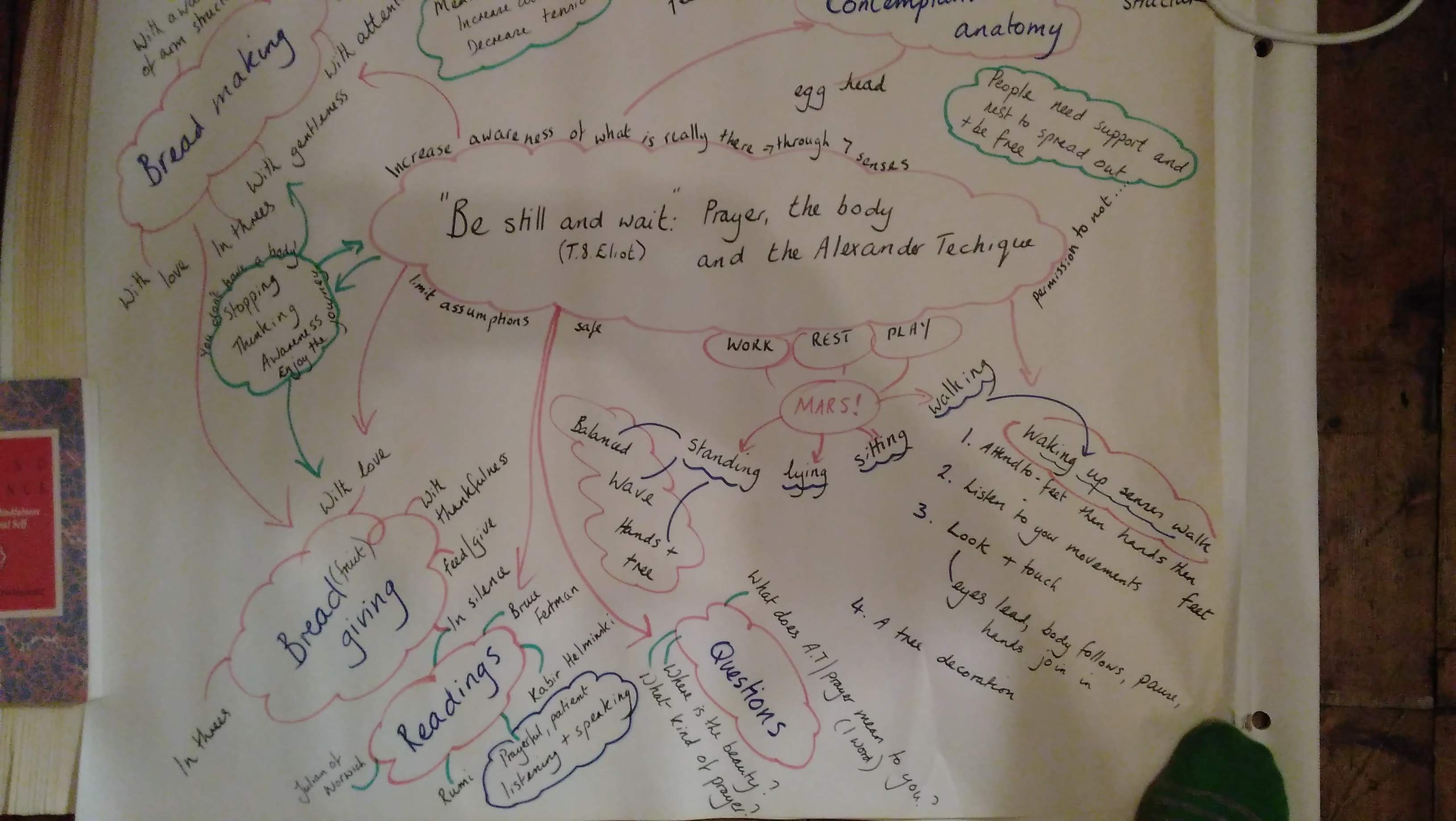
Be Still and wait: prayer, the body and the Alexander Technique – reflections on a workshop

What I LOVE about teaching the Alexander technique in groups and workshops are the WONDERFUL people who rock up to them! AND how much I learn. And last Saturday’s workshop, Be Still and Wait: Prayer, the body and the Alexander Technique, was no exception.

A few were people I knew already – including my husband who was an extraordinarily kind, unobtrusive, supportive gofer. Mostly, they were people I didn’t know – from Manchester, from Whaley Bridge, from Wildboarclough.

I was nervous. I hadn’t run a workshop on prayer and the AT before. But mostly I was thrilled that people had come to explore and to be open – and above all to PLAY – with these most important topics. And I opened by saying that I am not an expert on either the Alexander technique nor prayer. But I am a student of both and that I was grateful for fellow students to study with.

And my first question could have generated another workshop just on its own. What, I asked, does the Alexander Technique mean to you now, in one word or short phrase? And what does prayer mean to you now, in one word or phrase?

And they said, after time for thought and discussion, that the Alexander technique means……openness, friendship, skeletons (!), balance, rootedness, awareness, posture, environment, connection, self-awareness, embodiment, harmony, alignment, poise, possibility.

Honestly, I was in awe of those responses! From people with a very little, or in some cases no, previous experience of the technique. Those who are relatively new to a discipline sometimes see it with a freshness and clarity that those who have studied for longer can miss.

And they said that prayer means ……silence, stillness, deep silence, laughter, connection, alignment, comfort, openness, harmony, uncertainty, conversation with God, environment, spiritual awareness, spiritual connection, balance, and friendship.

And we looked at our lists with some amazement, all struck by the overlap, the similarities and connections between them. And I COULD have asked – are there any words or phrases from either list that could NOT go on the other? But we had sat and talked long enough and I wanted them up and moving 🙂

So I will save that question for another workshop.

So what did we do then? Well, we did some contemplative anatomy, something I have learned from one of MY teachers, Bruce Fertman, Peaceful Body School. We looked at the fact that we have, not two arms but one arm structure and at how wide and spacious that arm structure is. And then, in threes and in silence, we made bread, softly, creatively, with love and gentleness and awareness of that spacious arm structure. It baked while we ate lunch, filling the space with a wonderful aroma and waking up the sense of smell as our morning activities had woken up our senses of touch, sight, hearing, kinaesthesia and proprioception.

IMG_20181210_172944

And I read, after lunch, from a book by Kabir Helminski Living Presence: A Sufi Way to Mindfulness and the Essential Self. And we engaged in patient, waiting, open listening and discussion. And we went for a walk, channeling our inner dinosaurs because the room was quite chilly by that time. And then we gave one another bread, the bread that we had made with love and attention and openness.

And we used our senses of touch and sight and kinaesthesia and proprioception to explore and choose and add a Christmas decoration to the Christmas tree in the church we were meeting in.

And then we said our goodbyes and said what we were taking away from our four hours together, four hours of playful exploration of the Alexander technique and prayer. And mostly what I take away is a memory of how beautiful humans are, how kind, how generous, how thoughtful, how funny. We are not all like that all the time. But we all CAN be like that, some of the time. And that, in this season of Advent, of waiting, gives me hope.

IMG_20181210_173235

My workshop plan – a playful plan for a playful workshop. And no, for students who know me well, we DIDN’T get through a fraction of it!

Character Strengths, Prayer, Spirituality, Storytelling

St Francis, a failure and a friendship

We think of Francis as a saint. But Francis didn’t think of himself that way, I suspect saints never do. Francis saw himself as a failure and this story is the story of one of those failures. It is a story set nearly 800 years ago, in fact it will be 800 years next year. It is the story of how Francis tried and failed to stop a war.

The war was the 5th Crusade. It is worth remembering that Christians have not always been people of peace. The 5th crusade was a crusade by Christians, against Jews, Muslims and heretics and it was breaking Francis’ heart. Francis had once been a soldier, he knew what violence was and he knew what it was to be a prisoner of war. But when Francis fell in love with the Risen Christ, he fell out of love with everything that puts barriers between people, the barriers of pride, power and wealth.

And in 1219 pride and power and wealth had already killed many people. To try and end the bloodshed, Francis went first to the Christians, begging Cardinal Pelagius, the Christian commander, to end the fighting. Pelagius refused.

So then Francis, and his friend Brother Illuminatus, went to the enemy instead, to the Muslim army against whom the Christians were fighting. They went to stop the war and they went to try and change the hearts of the enemy so that they would follow the Risen Christ.

And they walked, the two of them, unarmed, through the camps of that enemy. They were captured and they were beaten. They were taken, finally, to the Muslim commander, the leader of their enemy, to Sultan Malik-al-Kamil of Egypt, an enemy leader who had offered a gold piece for the head of every Christian. And when Francis was led into the Sultan’s tent he said ‘May the Lord give you peace’. It is said that the Sultan was startled to hear a greeting so close to the traditional Muslim greeting of peace, Assalam o alaikum (as-saa-laam-muu-ah-lay-kum), Peace be upon you.

And in the meeting that followed, I am first going to tell you what Francis DIDN’T DO, because I think it’s important.  Francis did not try to deny the truths of the Muslim faith. He did not insult Islam. He did not argue or attempt to convince this enemy unbeliever that he was wrong.

What Francis respectfully did was to tell the Sultan the truth of why he was there – that he was there because of the gospel of love, that he was there because of his love for the Risen Christ, that he was there because he had been sent there by the God who IS love, And that he was there because of his love for his enemy – for Sultan Malik – al- Kamil. And the Sultan listened to this gentle, foolish, ridiculous man of God, sitting in his tent, speaking truth about love.

And then, in his turn, the Sultan told Francis, truthfully, about the faith and the prayers and the practices that HE loved.  And the gentle, foolish ridiculous man of God listened in his turn. Because that is what love does, that is what friendship does, it listens.

And then Francis left. And the war continued. And the Sultan continued to be a Muslim. Which meant that Francis had failed. He had failed to stop the war. He had failed to convert the Sultan.

But it is said that the Sultan was changed by his encounter with Francis, with the gentle, foolish follower of the Risen Christ. It is said that after meeting Francis he treated Christian prisoners with unusual and unexpected kindness and respect. And perhaps that is as much because of what Francis didn’t do, as what he said. As much because of what Francis WAS – a gentle, foolish, ridiculously loving man of God.

And it was not only the Sultan who was changed. Francis loved the fact that the Muslims prayed 5 times a day. So when he went home he asked his brothers and sisters to do the same. And though Francis refused the many rich gifts that the Sultan offered him, because Francis was not terribly interested in stuff, he did accept the gift of a horn used to call Muslims to prayer. And when he got home he used it to call Christians to prayer. Five times a day.

And perhaps he listened, too, to the beautiful Islamic tradition of the 99 names of God. Because when he got home he wrote a song, the song we are about to share, called the Praises of God. There are not 99 names in it. But then Francis was a humble man. But, if you count carefully, there are 33 names in it. 33 names of the God Francis loved, the God who sent him not to argue with his enemy but to listen and to speak truth about love and to be changed by his enemy, to become his enemy’s friend.

Francis saw himself as a failure. I think that the Sultan and the Risen Christ saw Francis as a friend.

Sources

www.darvish.wordpress.com

www.aleteia.org