An Anglican priest and Alexander technique teacher
Author: Dr. Jennifer Fox Eades
Alexander technique teacher, writer, researcher, education adviser, member of Third Order of Society of St Francis. Interested in the Alexander technique as a source of well-being, contemplative education, stories and storytelling, and embodied learning and praying
Given the coverage of the Lambeth Conference in both church and secular press in recent weeks I have decided it is time to say clearly and simply that I am an ordinand (trainee priest) in the Church of England who hopes, and prays, that my church will soon end its discrimination agains LGBTQ+ people (and end discrimination on grounds of sex, class, race, disability and age, too). I hope and pray that we will welcome and respect all equally and marry same sex couples, as the Episcopal Scottish Church, the Chuch of Scotland, the Church of Wales and the Methodists in the UK have decided to do.
And I hope, very much, that he meets her and listens to her and that they become friends.
Because, most of all, I want us to learn to disagree better – without shouting at each other, walking out of the room, or going to war. I don’t, personally, think Jesus of Nazareth said ANYTHING about sexuality. What he taught us was how to tackle the difficult task of being human, well and how to challenge antihuman forces, practices and beliefs that bring death to people, rather than life.
The issue around sexuality masks a deeper issue that is really about the different ways people of faith read their holy texts. Do we read them literally, as handbooks, telling us what to do and what not to do? Or do we read them as complex products of their time and place, holy poetry, Wisdom literatures that can and do speak to us and inspire us but which also come to us from violent times and places where women, children, sexual minorities, the disabled were seen as ‘less’ than?
With other feminist theologians I want to point out that our scriptures and our creeds were written by and mostly about the actions and beliefs of powerful (straight) men and present us with male imagery for a powerful and masculine God. Our holy texts have been and still are mis-used to oppress and bring death, not life, despair and hate, not hope.
That does not mean I reject the bible or the traditions of my church but I don’t simply ‘accept’ them either. They are to be wrestled with, argued with and searched for the treasures they can and still do yield to us. I revere the bible but I don’t think it’s a simple book with a single message. It inspires and moves me, angers me and troubles me, comforts me and helps me to be human.
And as there are many voices and messages in the bible, though some are quieter than others, so I would like us as people of faith to acknowlege the value of multiple perspectives, many voices. I want us to listen to the voices of the LGBTQ+ community, of children, of women and the poor and the disabled, of minorities and learn what they can tell us of the Divine.
And I very much want Christianity to move on from its obsession with disapproving of what people do in bed and to focus much more on that difficult task of being human, well. Because that’s what I think religion is for …. to help us to be kinder to each other and to the planet and to ourselves. Simple. Albeit, not easy.
Something not many people know about me is that I love going barefoot and always have. I nearly decided to go barefoot when preaching this sermon but then realised that that would be one of those sermon illustrations my preaching tutor warned us about, which is SO exciting and unusual that people get totally distracted and end up not listening to a word you say – so my listeners would be thinking, what is this mad woman doing coming to church with no shoes on – and the rest of the sermon would pass by unnoticed.
So…I kept my shoes on and went metaphorically barefoot instead!
I go barefoot at home for most of the summer, I often go barefoot in the garden, I have even gone barefoot running – which is a thing now – and I did a lot of martial arts as a child – all of which is done barefoot. In fact it still strikes me as a little odd that we don’t take our shoes off when we come into church. Other traditions – Buddhists , my Muslim friends – all take off their shoes when entering a sacred space but Christians don’t. I suspect in our climate that has a lot to do with the fact that we build with stone and we would all have chilblains by the end of the winter.
The reason I am telling you all this is that I think it matters how Jesus sends out his followers in the passage from Luke we heard read for us. Not only are they to take no purse or bag but no sandals either and at least one translation I read said, quite explicitly, go barefoot.
Why might that matter. Well, as someone said when they read that translation, it’s hard to trample on other people when you’re barefoot. And that may explain the popularity of the barefoot schools movement – it started in Scandinavia and has spread here. Everyone in the school, staff, children, visitors, take off their shoes. The education professor researching the results – which range from improved academic results and behaviour to a decline in bullying and carpet wear and tear – says his pet theory is that teenage boys keep their testosterone in their shoes. As that person said, it’s hard to trample on people when you’re barefoot.
Going barefoot in the ancient world was a sign of humility, of low status. Spiritual teachers might well go barefoot – it was the rich, the powerful who wore shoes.
And when you go barefoot you have to tread more gently, you have to keep more aware of the ground under your feet, of the terrain in front of you – you literally have to tread lightly on the earth.
You are, in fact, less protected and more vulnerable. So, when Jesus sends out people to carry on his work, he asks them to go humbly, gently, to let themselves be vulnerable. Lambs among wolves. As Jesus was humble, gentle, vulnerable – a lamb among wolves.
The spiritual life is not, or never should be, about trampling on others. It is about being vulnerable, gentle, humble.
But here’s the thing about lambs. They are vulnerable. They are also wonderfully playful. I heard a great sermon last term where one of our tutors told us that that thing that lambs do when they jump straight up in the air? It’s called stoating! Because, apparently, stoats do it too. Lambs are exuberant, joyful. And that’s the other truth about the spiritual life, the call to follow in the footsteps of Jesus of Nazareth – it is, or it should be, also about playfulness and joy, as well as vulnerability.
Workers or teachers? Or even learners?
This text is often spoken of in the context of the word mission, a sending out to spread good news. But notice how, in addition to the fact that those engaging in mission should go barefoot, so they can’t possibly trample on anyone, they were also told to be open to receive, as well as to give. They received hospitality. If their host was a person of peace they shared in that peace. They were fed. In response they were to heal, to make people whole and they were to teach – the word for worker or labourer could also mean teacher – and what they were teaching was that the ‘kingdom of God’ was near.
It is easy to think of mission as some we do to others. Here mission is two way, as true teaching is always two way. The true teacher is always also learning from others. Here the people Jesus sends are also receiving blessings from those they meet and bless. Mission, the work of God in the world to bring about justice and peace and kindness – is always reciprocal and should always promote the welfare of everyone involved.
The other thing about teaching is that you cannot teach what you are not practising yourself. We cannot teach others that the kingdom of heaven is near if we are not ourselves always learning to see that the kingdom is at hand. And that is a hard practice and a lifelong practice. It is the practice of paying attention. An attentiveness that is encouraged by going barefoot, though I am not suggesting you literally go barefoot in Stockport. But more that you might think about what it means for the spiritual life to walk gently and with awareness. To stay awake. To notice the beauty around you. The beauty in each person. To recall moment by moment that God is near, that the person with me is a child of God, that the kingdom is at hand.
You’ll never walk alone
So Jesus sends us out barefoot, to walk gently. To be vulnerable but playful. To receive as well to give. And he sends us in pairs. We might be vulnerable, in whatever role or calling we are walking in, but we are not alone.
On Monday I took part in about 45 minutes of what we call Holy Listening though it’s more properly called Lectio divina or holy reading. It’s a kind of prayer using the bible. About 7 people gathered at St Peter’s Macclesfield and we sat and read and reread the passage that would be preached on this morning. There’s a lot of silence and a lot of listening and then people shared what they felt spoke to them in the passage. And some of the ideas in my sermon came from people’s sharings. It’s less MY sermon and more a group effort. And that’s a lovely metaphor for the spiritual life and for church life. It is, it should always be, collaborative.
Holy listening in a small group on a Monday morning is a terrific way to start the week and I commend it to you as something to think about – not least because it’s a great way for you to love and support your clergy and help them with their sermon preparation. But also because it builds community – it builds the kingdom of heaven. Some writers now are using the word ‘kin-dom’ rather than Kingdom – for various reasons but importantly because it makes the point that we are all sisters and brothers in the realm of God and that everyone belongs here.
I started this sermon with a prayer taken from our Galatians passage:
“Far be it for me to glory except in the cross of our Lord Jesus Christ, through whom the world is crucified to me, and I to the world’
So, what is this ‘world’ that is crucified to me? Well, it’s the world that says being vulnerable is stupid and for losers. The world that says it’s ok to trample on others and which sees gentleness as a sign of weakness. The world that is preoccupied with efficiency and success – going barefoot isn’t efficient and Christ’s death was not a success. That is the world that is crucified. But the resurrection hope on the other side of that is that the kin-dom of heaven is close at hand, then, now, in and around each of us and we are all constantly being called into newness, into the future, into hope and gentleness and the playful vulnerability that is at the heart of the kin-dom of heaven.
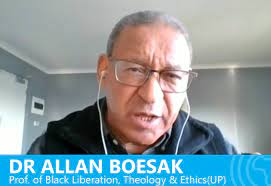
One of the privileges of studying theology and ministry at The Queens Foundation https://www.queens.ac.uk/ is that we are able to learn from superb Black academics like Dr Carlton Turner and Dr Dulcie Dixon-McKenzie. And they, in turn, introduce us to a wider world of theology and struggle and resistance and liberation. And to seasoned activist theologians like Professor Allan Boesak who, at the age of 77, is still a thorn in the flesh of unjust powers.
It is a conversation between Dulcie and Professor Boesak entitled Preaching Hope and Resistance in Times of Struggle and was an hour very well spent. I commend it.
I remember Allan Boesak from my youth but at that time did not clearly understand the depth of the anguish and suffering of Apartheid or the complicity of the White Christian churches.
And what impressed me most, from this interview, was that Allan Boesak is STILL thinking and changing and growing. His theology is as relevant today in the struggles we face against sexism, classism, homophobia, exploitation and ecocide as in the ongoing struggle against racism that he has devoted his life to. Jesus, Allan says repeatedly, was and IS a revolutionary and to walk his Way is to walk the way of struggle and justice.
His latest book is Children of the Waters of Meribah: Black Liberation Theology, the Miriamic Tradition, and the Challenges of 21st Century Empire. It’s a book that argues for the voices of women in Scripture, voices of peace to set against the violence of Empire. I haven’t read it yet. It has just gone to the top of my ‘to read’ list…..
Recently I have developed an alter ego. This alter ego is a litter fairy. She is fast becoming just a little bit obsessive about keeping her locality free from litter.
Now, I have always hated litter. My family will tell you that my usual liberal tendencies fly out the window in the face of people who just can’t be bothered to put their crisp packet in a bin and leave it for others. I thought prison was probably too good for such people. And I got cross about it – I even ranted about it. And yet I still DID nothing about it. It was ‘the council’s’ job – an SEP – somebody else’s problem.
But whether it has been the increased focus on climate change and our environment in the news or the drip, drip, drip of reading Richard Rohr’s Franciscan Daily Meditations from the Center for Action and Contemplation https://cac.org/ I am not sure but I now see things a little differently. I have decided that this is MY planet, MY town, MY street and I can and want to do something, just a little thing, to care for it. And that little thing is, most days and most walks, picking up the crisp packet, the chocolate wrapper and the beer can or McDonald’s cup and putting them in the nearest bin.
You could say that, from being an SEP, somebody else’s problem, I have made it MY problem. But, here’s the interesting thing, it no longer feels like a problem. Seeing picking up a crisp packet as a way of caring for our Mother Earth somehow changes the feel of it. I don’t feel angry anymore – I feel it’s an opportunity to do something, something admittedly very small – for my neighbours, for my street, for my town. And now, rather than getting angry with the folk who drop litter, it occurs to me that people who are careless probably don’t feel very cared for. People who drop litter can’t see the beauty of their environment – don’t know that it is a gift to them to be enjoyed and appreciated – and that is very, very sad. So now, when I pick up the crisp packet I also pray for my Sister or Brother Litter Dropper – that they might see a little more of God’s beautiful world and feel just a tiny bit more cared for.
So, a spiritual practice for Lent? If we all picked up three pieces of litter on every walk we took in Lent our town, our country, our city would look – and feel – more cared for. Which I would call Good News.
Appreciating Church is a handbook style
resource book based on an ecumenical project of the same name. The aim of the
project is to create ‘communities of practice’ – groups that foster change in
positive, hopeful, inclusive and encouraging ways. Behind the project, and
behind the book, is the organizational practice of Appreciative Inquiry, a
practice that is based on looking for the best in people and in organizations.
Developed by David Cooperrider, appreciative inquiry and, by extension,
Appreciating Church start NOT from the viewpoint that organizations are
problems to be solved, but that they are miracles of human organizing and
ingenuity – to be appreciated.
I heard Cooperrider speak once. He is both
the son and the father of Christian ministers. His belief in the potential of
human goodness to bring about positive change in the world was palpable and
deeply inspiring. He was perhaps the most hope filled person I have ever met.
Cooperrider’s key insight is that if you go looking for problems you will find
them – and you are then likely to get bogged down in them. If you ask different
questions – questions about when an organization is at its best, when its
people are at their best, you don’t cover over the difficulties but you do help
to generate the imagination, the creativity and the energy needed to move
beyond them. In every system, every church, every person – something is
working, something good is happening. Appreciative inquiry seeks to find that
goodness and to grow it.
Appreciating Church is a practical resource
for bringing some of that hope filled appreciation into churches and church
projects. It does this by bringing together a bit of theory, a lot of stories
and a lot of resources to help communities see themselves and the future a little
bit differently. As a church leader, I particularly liked – and will be able to
quickly and easily use – the practical suggestions for introducing an
appreciative approach into meetings and also its use for the discipline of
spiritual journaling.
Richard Rohr describes contemplation as a
way of seeing that includes recognizing and appreciating. I have worked with
appreciative inquiry in the past and recognize its overlap with the
contemplative path. Appreciating Church seems to me to be one more way in which
the essential spiritual path of contemplation is being reinvigorated for
today’s church.
An Alexander Class for Parents and Carers (babies welcome)
Mondays 1.30 – 2.30 £10 per class or £45 for 7 weeks
Learning the principles of mindful movement – working WITH our bodies, not against them. Help yourself to easier movement and learn how to support your developing child as they grow.
Clinical trials show the Alexander Technique provides substantial long term relief from lower back pain. It is in the NICE guidelines for Parkinson’s disease to relieve symptoms, including depression and improve balance. It is relaxing, grounding, stress reducing….it can be life changing.
An excellent talk on movement and why the fitness industry gets it badly wrong from a fitness expert and male model, Roger Frampton. He highlights the ridiculous practice of Western cultures of taking master movers – also known as children – who squat naturally and with ease and then teaching them to SIT for 7 or 8 hours a day.
I suspect that this single practice, the practice of replacing the natural human positions of standing and squatting with sitting on that man made, modern and malign invention THE CHAIR probably contributes more to the epidemic of back pain in the Western world than anything else.
Sitting, slumped over, limits our breathing, contracts our spines, weakens our core muscles and probably much more. We used to squat – Frampton calls it the ‘pre-chair resting position’ – why were we made to stop???
Frampton says we should watch children to understand how our bodies want to move and try to get back our full range of movement – the movement we once had. He criticizes the outcome focus of the fitness industry – constantly measuring time, distance, repetitions, weight – and says we should focus instead on HOW we move – and focus on movement, not looks, not muscles. Work with your body, not against it, he says and prioritize the spine. You are, as a Chinese saying has it, as old as your spine.
So, the Alexander Technique – not about posture but about movement – put movement first, understand how your body wants to move, used to move – find an Alexander teacher or, perhaps better still, watch a small child.
On Saturday, 16 people turned up at St Peter’s Church, Macclesfield to explore the simple, yet complex movement of walking. We all know how to walk. What we don’t always know is how WE walk and how we might walk with more ease, more enjoyment. And that is what we explored together.
And it was immense fun – a really good workshop. And people learned a great deal. And we metaphorically covered a great deal of ground though we physically didn’t walk any great distances.
And looking back on any workshop or group session I COULD pat myself on the back, as the person running the workshop and say ‘well-done, I ran a good workshop’. Or, alternatively, ‘that didn’t work, I must not be a very good teacher’. And in these days of an education system that measures teachers on how well their students do, that is certainly a tendency. But that view, it seems to me, puts TOO much emphasis on the role of the teacher and not enough on the role of everyone else in the room.
It’s not that the teacher has NO role or responsibility. Of course they do. It was my job, yesterday, to ensure that the physical and emotional environment was as safe as possible – that people knew they weren’t going to be judged or criticized. I try to make sure the physical environment is as beautiful as possible too – that tells participants I value them. As does the fruit and treacle flap jack at break time. And it’s my job to be as skillful a teacher as I can be, to keep studying and learning myself and to teach as clearly as I know how. I am responsible for the pace of the workshop, the content of the workshop.
On this particular afternoon I was also lucky enough to have two other Alexander technique teachers to help me, the lovely Janey Goodearl and the wonderful Su Harrison.
But – and it is an important but – the other people in the room play an absolutely essential role in the success of any workshop. Their openness to learning, their generosity to one another, their courage in being willing to change and look at new ways of doing things are things the teacher or workshop leader can encourage but not actually give. Only the participants can do that.
So, as I look back on Saturday’s workshop and reflect on it, I have to pay tribute to the open-hearted, warm, friendly and open-minded participants for the learning that took place. To Janey and to Su, for their invaluable help and to all the lovely people who came together to form a community of learning the Alexander technique together.
If we learn, we change. And at the end of four hours, people had changed. They said,
‘I feel safe and more stable and more appreciative of the ground’
‘I learned how strong my lower body is’
‘when I went for a walk I thought more about the process of walking instead of being in my head’
‘I felt more grounded, more connected with the ground’
‘I felt a lot more stable, I looked up, I enjoyed going for a walk!’
‘I’m taking away a sense of freedom and stability’
‘I’m taking away the need to slow down’
‘I’m going to be a bit gentler with myself about change’
‘I learned that holding yourself rigid is a silly waste of effort’
Well done, those students of the Alexander work. And thank you for a good afternoon’s learning.